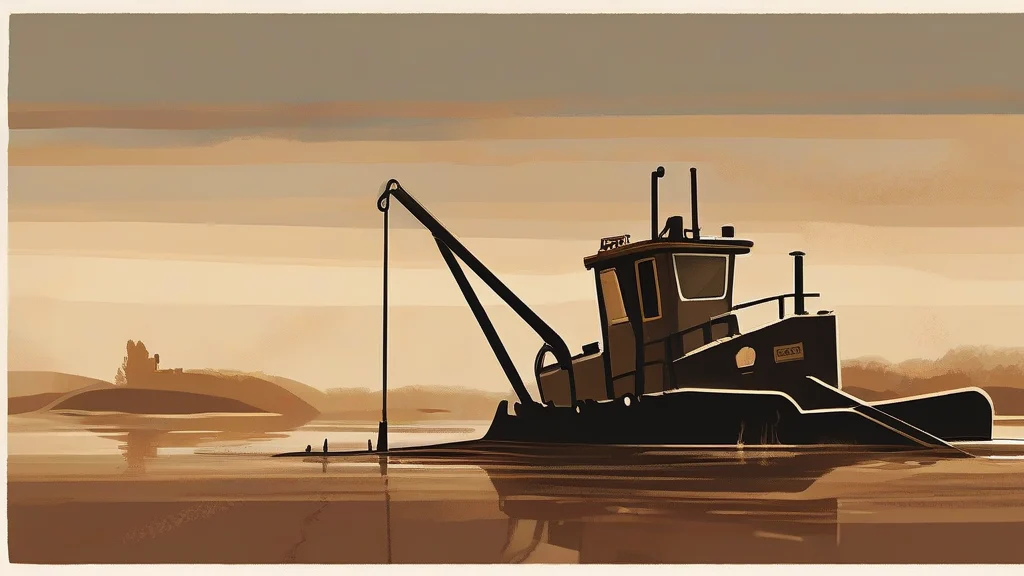
What does dredge mean?
Dredge functions both as a noun and a verb, rooted in the world of waterways and heavy machinery. As a noun it names the machine or vessel that scoops sediment from the beds of rivers, lakes, and harbours; as a verb it describes the act of clearing such material away to keep channels deep enough for ships. Figuratively, to dredge often means to search exhaustively through something, or to drag buried matters — usually painful memories or old disputes — back into the open, as in 'dredge up the past.' In kitchens, particularly in American usage, dredge also refers to lightly coating food with flour or breadcrumbs before frying. The word carries a slightly laborious, industrial connotation, evoking effort and disturbance of settled things. Its flexibility across engineering, memory, and cookery makes it a compact, vivid term worth knowing.
A machine or boat fitted with a scoop, bucket, or suction apparatus for removing mud, sand, and sediment from the bottom of a body of water.
"The dredge operated continuously for three weeks to restore the channel's depth."
Also historically applied to a dragnet or net used for gathering shellfish.
To clear out or deepen a waterway using a dredge; to search through something exhaustively; to coat food lightly with flour, sugar, or crumbs.
"They dredged the river every spring to prevent flooding."
The culinary sense is common in American English.
Standard English plural.
"Two large dredges were stationed at the mouth of the estuary."
Every year dredgers pull millions of tonnes of sediment from the world's ports — without them, most major harbours would simply silt shut.
Reviewed by Deb Chak, Editor. AI-assisted content curated by RJS Tech Solutions LLP.
Etymology of dredge
The word 'dredge' first appeared in English around the late 15th century, likely borrowed from Middle Dutch 'dreghe' or a related Germanic source referring to a tool for dragging or scooping. Its original sense was tied to fishing gear used to scrape the seabed for oysters and shellfish, later extended to machines that cleared sediment from waterways. The verb form developed naturally from the noun, and its figurative use — searching through or unearthing hidden things — followed from the physical act of raking through mud and silt. Cognates exist across Dutch and Low German dialects, reflecting the maritime culture where the word originated.
Related word forms
How dredge is actually used
In cooking contexts (especially American English), 'to dredge' means coating food with flour or breadcrumbs. 'Dredge up' almost always carries a negative connotation when applied to memories or past events.
Easily confused with dredge
A drudge is a person who does tedious, menial work, whereas a dredge clears material from a waterway — they differ in both meaning and spelling.