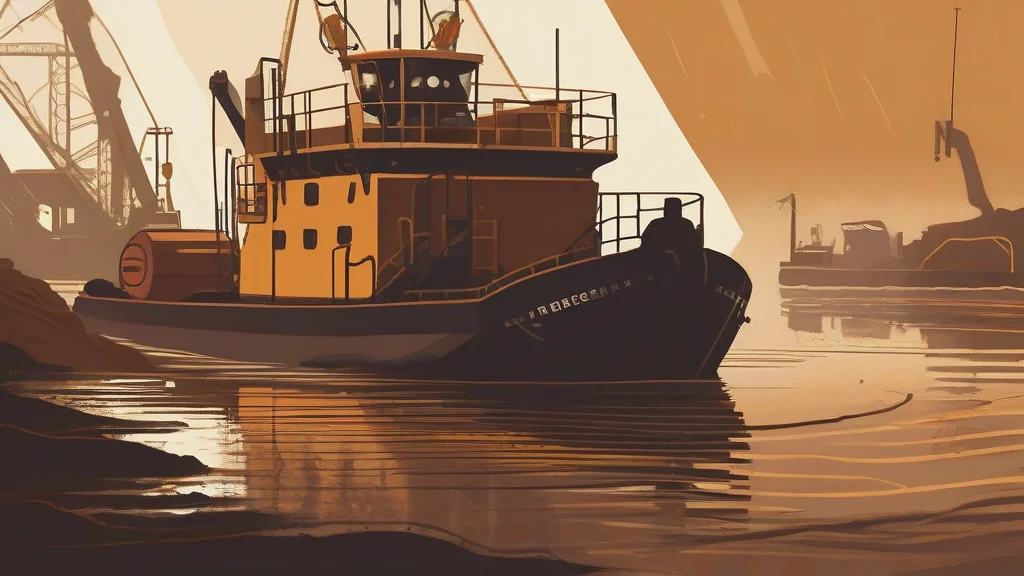
What does dredging mean?
Dredging is the practice of removing mud, sand, silt, and other sediment from the bottom of rivers, harbours, canals, and coastal waters, usually to keep shipping channels deep enough for vessels to pass safely. It is carried out with specialised floating machines called dredgers, which scoop or suction material from the seabed and either deposit it elsewhere or transport it ashore. Beyond navigation, dredging supplies construction materials such as sand and gravel, supports land reclamation projects, and helps clear contaminated sediments from polluted waterways as part of environmental remediation. The word carries a distinctly technical, industrial tone and appears often in maritime engineering and environmental news, where it sometimes attracts criticism over its effects on aquatic ecosystems. Without regular dredging, many of the world's busiest ports would gradually become impassable as natural sedimentation filled their channels, making this unglamorous activity essential to global trade.
The action or process of removing sediment from the bed of a waterway to deepen or clear it; also, the commercial extraction of underwater materials such as sand or gravel.
"The dredging of the canal took nearly six months to complete."
Usually treated as an uncountable mass noun in technical writing; countable uses ("a dredging") are rare.
Present participle of dredge: to clear out or deepen a waterway by scooping sediment from its bed, or to gather material from underwater.
"They are dredging the river mouth to restore access for fishing boats."
Every year, ports around the world remove millions of tonnes of sand and silt just to stop their harbours slowly silting up — without dredging, most major shipping routes would simply disappear.
Reviewed by Deb Chak, Editor. AI-assisted content curated by RJS Tech Solutions LLP.
Etymology of dredging
The word dredge, from which dredging derives, first appeared in English in the late 15th or early 16th century, originally denoting a tool for gathering oysters or other shellfish from the seabed. Its further origin is uncertain; some sources link it to Old English dragan ("to draw"), while others suggest borrowing from a related Germanic or Dutch term, so etymologists generally describe the derivation as obscure rather than asserting a single source. From the tool, the verb extended naturally to the broader activity of scooping up material underwater. Related forms such as dredger (the vessel or person) and dredgeman developed alongside it during the expansion of commercial waterway engineering.
Related word forms
How dredging is actually used
"Dredging" is largely technical or industrial in register, appearing frequently in engineering, environmental, and maritime contexts. In environmental reporting it can carry a slightly negative connotation when referring to damage caused by disturbing riverbeds or marine habitats. As the -ing form of "dredge", it also functions as a gerund in everyday sentences (e.g., "Dredging takes place every spring"). Note that the verb "dredge" has an unrelated culinary sense — sprinkling food with flour or sugar — but the noun "dredging" almost always refers to the excavation sense.
Easily confused with dredging
Drawing means sketching, pulling, or extracting something, whereas dredging specifically involves scooping sediment from the bottom of waterways.