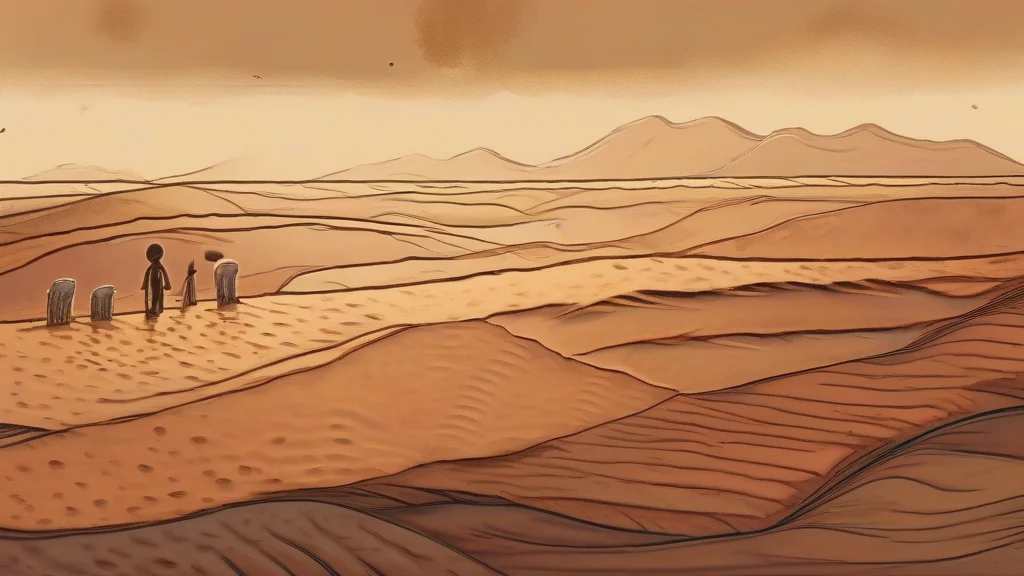
What does driest mean?
'Driest' is the superlative form of the adjective 'dry', describing something that possesses the least moisture or liquid of all. Its literal uses are common in weather and climate reporting — one might speak of the driest month on record or the driest region of a country — as well as in everyday contexts such as skin, wine, or soil. Beyond the physical sense, 'driest' also describes style: dry prose is plain and factual, while dry wit is delivered with a deadpan, understated quality that can be highly effective precisely because it lacks obvious emotional display. In this figurative use, calling someone's humour the driest in the room is often a compliment to their subtlety. The word derives from Old English 'dryge', which also gave English 'drought'. Whether describing an arid landscape or a perfectly timed deadpan remark, 'driest' marks the extreme end of the spectrum of dryness.
adjective (superlative of 'dry')The superlative form of 'dry', meaning the most free from moisture or liquid, or the most lacking in interest, emotion, or humour.
- Most free from moisture or liquid.
- Most lacking in rainfall or water supply.
- Most dull or uninteresting in style or delivery.
- Most understated or laconic in humour.
"August was the driest month on record for the region."
"It was the driest summer the valley had seen in decades."
"He delivered the driest remark of the evening without so much as a smile."
Both 'drier/dryer' and 'drier/driest' are correct — but 'driest' has long been the preferred spelling for the superlative in careful writing.
Reviewed by Deb Chak, Editor. AI-assisted content curated by RJS Tech Solutions LLP.
Etymology of driest
'Driest' is the superlative of 'dry', which comes from Old English 'drȳge', meaning free from moisture. This Germanic root also produced Middle English forms such as 'drouth' and modern 'drought', which share the same origin. Cognates appear in other Germanic languages, reflecting a shared ancestral word for aridity.
Related word forms
How driest is actually used
Used both literally (weather, climate, materials) and figuratively (wit, humour, prose). The figurative sense carries a connotation of understated irony rather than outright dullness when applied to humour.
Easily confused with driest
'Drier' is the comparative form meaning more dry, while 'driest' is the superlative meaning most dry.