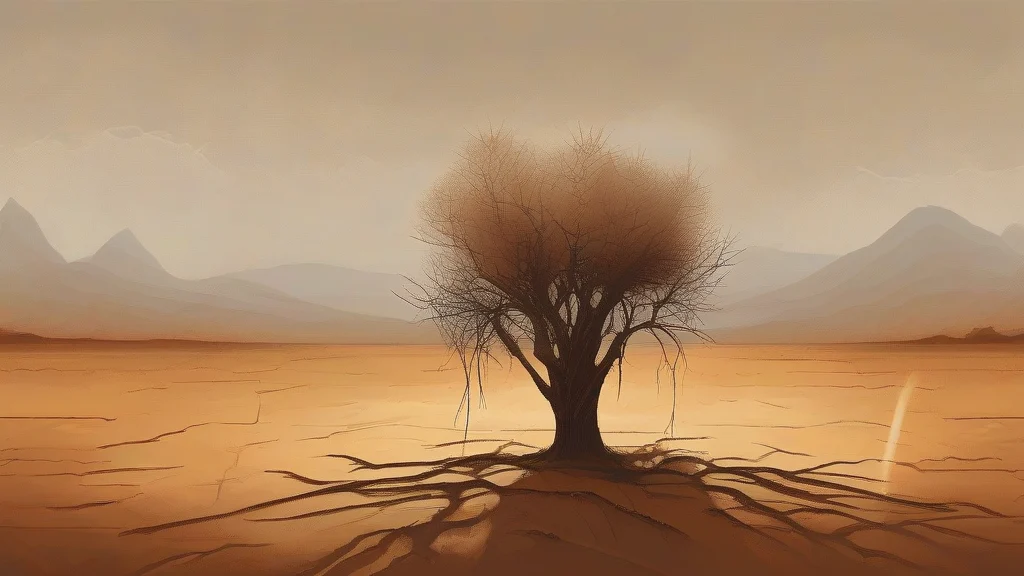
What does droughtiness mean?
Droughtiness is a noun denoting the state or characteristic of being droughty — that is, marked by persistent, pronounced dryness of weather, soil, or land. Where "drought" names a discrete event, a specific stretch of abnormally low rainfall, "droughtiness" captures something broader and more habitual: the ongoing tendency of a place or period toward aridity. A farmer might speak of the droughtiness of a region's summers, or a gardener of the droughtiness of a sandy slope that drains almost immediately after rain. The word is comparatively uncommon and leans formal or literary, appearing chiefly in agricultural, meteorological, and descriptive writing where precision about sustained dryness matters. It carries a largely neutral connotation, though it often implies hardship or limitation for cultivation. Related forms include the adjective "droughty," used of land or seasons prone to drying out.
nounThe state or condition of being droughty; persistent dryness of weather, climate, soil, or land, especially when severe enough to threaten vegetation or crops.
- The condition or quality of being unusually or persistently dry, whether of climate, weather, soil, or land.
"The droughtiness of the high plains made farming a gamble every single season."
"Farmers have learned to breed crops suited to the droughtiness of the region."
"The report attributed the vineyard's success partly to the natural droughtiness of its stony hillside soils."
As an abstract noun it is nearly always uncountable; a plural form exists grammatically but is essentially never used except when referring to distinct instances of dryness in different places or periods.
Droughtiness isn't just about rain — it's the word you reach for when dryness becomes a place's defining personality trait.
Reviewed by Deb Chak, Editor. AI-assisted content curated by RJS Tech Solutions LLP.
Etymology of droughtiness
Droughtiness is formed from "droughty," an adjective meaning dry or characterized by drought, combined with the common English noun-forming suffix "-ness." The base word "drought" descends from Old English "drūgaþ," meaning dryness, derived ultimately from the Proto-Germanic root underlying "dry." The word is thus thoroughly Germanic in origin rather than Latinate, making it etymologically a cousin of everyday "dry." Its development into an abstract noun follows the standard pattern by which English adjectives yield qualities via "-ness."
Related word forms
How droughtiness is actually used
A relatively rare, somewhat formal word; speakers more commonly say "dryness" or refer directly to "drought conditions." It appears most often in agricultural, climatic, and regional-descriptive writing.
Easily confused with droughtiness
"Drought" is the common noun for a prolonged period without rain, while "droughtiness" is a rarer abstract noun describing the general quality or tendency toward such dryness.
"Draught" (British spelling) refers to a current of air, a drink, or the drawing of a load — an entirely different word that happens to share pronunciation and much spelling history with "drought."