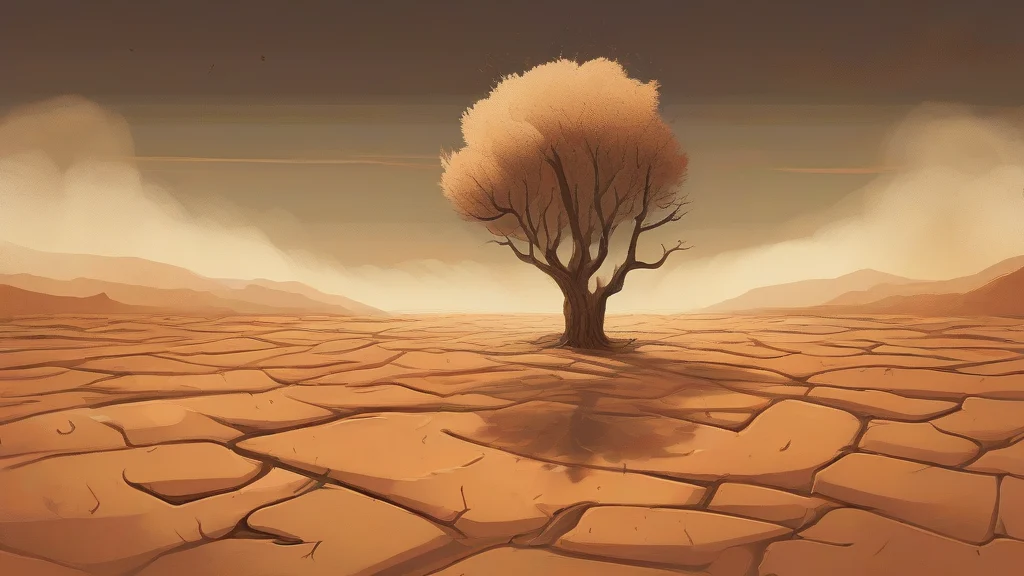
What does droughty mean?
"Droughty" is an adjective used to describe weather, seasons, regions, or land that is marked by drought — that is, suffering from a prolonged absence of rain. A farmer might speak of a droughty summer that scorched the crops, or a gardener might note that only hardy plants survive the region's droughty climate. The word is more specific than "dry": it implies an extended, abnormal shortage of rainfall rather than ordinary aridity, and it is most at home in agricultural and meteorological contexts. Though perfectly standard English, it has a slightly literary or old-fashioned flavor and appears far less often than synonyms like "arid," "parched," or simply "dry." Formed from the noun "drought" plus the adjectival suffix "-y," it also yields comparative and superlative forms, "droughtier" and "droughtiest," though these are uncommon. Learners should take care not to confuse it with "draughty," which refers to cold air currents indoors.
adjectiveCharacterized by or experiencing drought; lacking rainfall and therefore unusually dry.
- (of weather, a season, or a region) marked by drought or prolonged lack of rain; unusually dry.
"The droughty summer left the wheat fields cracked and barren."
"Farmers watched their droughty pastures turn to dust as the rains failed week after week."
"The vineyard thrived in the region's droughty climate, where stressed vines produce intensely flavored grapes."
Despite its tidy spelling, "droughty" hides a silent gh inherited from Old English — the same ghost letters you trip over in "drought" and "thought."
Reviewed by Deb Chak, Editor. AI-assisted content curated by RJS Tech Solutions LLP.
Etymology of droughty
"Droughty" is formed within English from the noun "drought" combined with the adjectival suffix "-y." "Drought" descends from Old English "drūgaþ," meaning dryness, from the Germanic root behind "dry." An older variant form, "drouth," preserves the Middle English development and survives in some dialects. The word thus belongs to a small Germanic-rooted family including "dry" and "dryness," rather than deriving from Latin or Greek.
Related word forms
How droughty is actually used
"Droughty" is a somewhat literary or regional adjective, less common than plain "dry" or "arid." It carries an agricultural connotation, often describing farmland, seasons, or climates rather than objects. The comparative "droughtier" and superlative "droughtiest" exist but are rare.
Easily confused with droughty
"Drought" is the noun referring to a prolonged period without rain, while "droughty" is the adjective describing conditions marked by such dryness.
"Draughty" describes a place with unwanted cold currents of air, whereas "droughty" describes land or weather that is excessively dry.