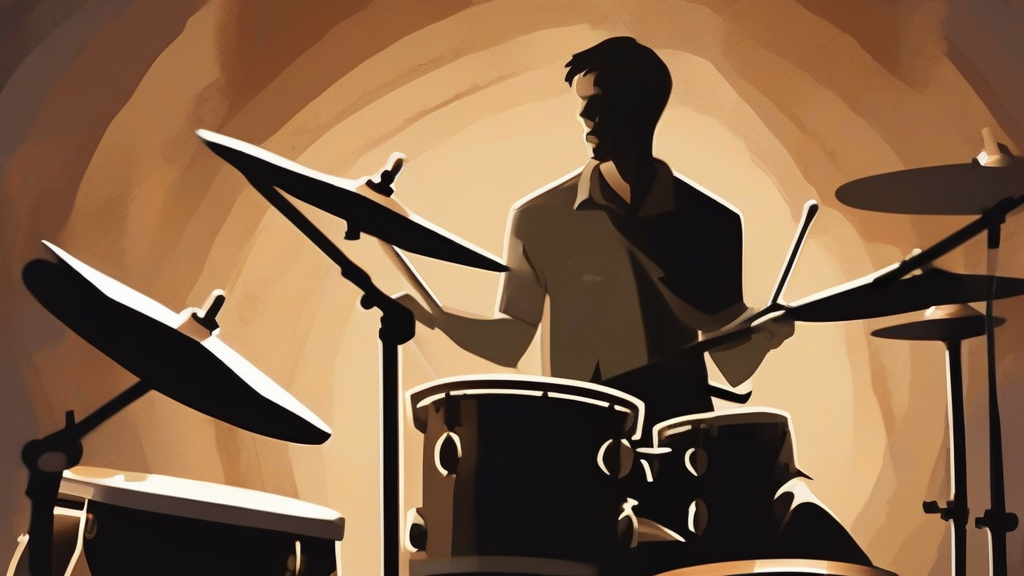
What does drummer mean?
A drummer is someone who plays a drum or, more commonly today, a drum kit — the percussionist who provides rhythm for a band, orchestra, or ensemble. The role sits at the heart of most popular music: rock, jazz, funk, and pop bands typically depend on the drummer to keep time and drive the energy of a performance. Drummers range from orchestral timpanists to session musicians who record with many artists. The word has an older, chiefly American sense meaning a traveling salesperson, now dated and mostly remembered through idioms. Figuratively, the phrase 'to march to the beat of a different drummer,' drawn from Thoreau's Walden, means to follow one's own path rather than conforming to others' expectations. Whether literal or figurative, the word evokes rhythm, discipline, and individuality, making it a vivid and culturally resonant term in English.
A person who plays a drum or drums, especially in a band or orchestra.
"The jazz club featured a brilliant young drummer from New Orleans."
Neutral register; the standard term for the musician in both British and American English.
(Informal, chiefly North American, dated) A traveling salesperson who solicits orders from retailers or households.
"Grandfather started out as a drummer for a hardware company, lugging samples from town to town."
Largely historical; understood mainly in older American writing and in the idiom 'drumming up business.'
Regular plural; used for both the musician sense and the dated salesman sense.
"The parade featured two drummers leading the marching band."
Thoreau told us to march to the beat of a different drummer — but every army since ancient times has relied on actual drummers to keep soldiers in step.
Reviewed by Deb Chak, Editor. AI-assisted content curated by RJS Tech Solutions LLP.
Etymology of drummer
'Drummer' is simply an agent noun formed from 'drum,' a word that appeared in English in the mid-sixteenth century, probably imitative of the sound of beating. The suffix '-er' denotes a person who performs the action, so a drummer is literally 'one who drums.' The word spread alongside military drumming traditions of the sixteenth and seventeenth centuries, when drummers kept troops in step and signaled commands. The American commercial sense arose in the mid-nineteenth century from the idea of a salesman 'drumming up' trade.
How drummer is actually used
The musical sense is neutral and universal. The 'traveling salesman' sense is informal and largely dated in American English; outside that idiom it may puzzle modern readers. In British English, 'drummer' almost always refers to the musician. The phrase 'marching to the beat of a different drummer' (popularized by Thoreau's line about marching to a 'different drummer') is well established in both regions.
Easily confused with drummer
Not a standard English word; any resemblance to 'drummer' is coincidental and it carries no dictionary meaning.