What does drusy mean?
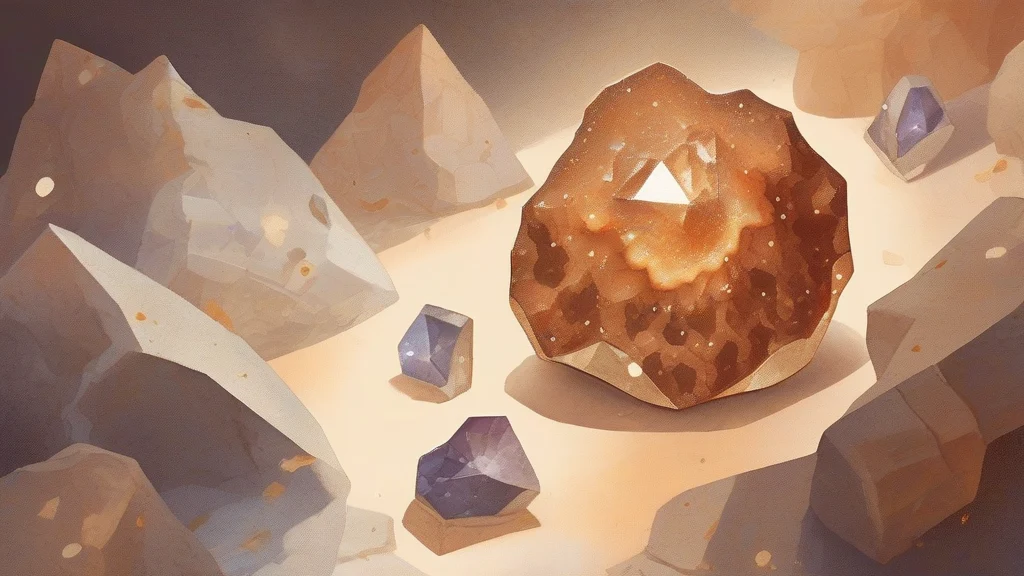
Drusy is a specialist adjective used in mineralogy to describe a rock surface or cavity that is coated with a layer of small, well-formed crystals. The word most often applies to the interiors of geodes and other hollow cavities in rock, where minerals such as quartz, amethyst or calcite have grown inward from the walls, producing a sparkling, sugar-like crust known as a druse. A collector might speak of a drusy vug, while a jeweller might feature a drusy slice of agate as the face of a pendant. The term derives from the German noun Druse, adopted into English geological usage in the nineteenth century. Though confined largely to scientific and lapidary contexts, drusy has gained wider visibility through the popularity of natural-crystal jewellery, and it conveys a vivid image of unexpected brilliance concealed within plain stone.
Covered with, consisting of, or relating to a crust of small crystals lining a cavity in rock.
"The drusy walls of the geode caught the lamplight like a ceiling of stars."
Chiefly used attributively before a noun (e.g. drusy quartz); occasionally used predicatively.
A druse; a crystal-lined rock cavity, or the crystalline crust itself.
"The specimen contained a fine drusy filled with milky quartz points."
The noun use is much rarer than the adjectival one; druse is normally preferred.
Applies only to the rare noun sense; the adjective is uninflected.
"The museum drawer held dozens of small drusies collected from the basalt flows."
Slice open an ordinary-looking rock and you might find a drusy pocket — a hidden cavern of glittering crystals that took millions of years to grow.
Reviewed by Deb Chak, Editor. AI-assisted content curated by RJS Tech Solutions LLP.
Etymology of drusy
The adjective drusy comes from the noun druse, which entered English in the nineteenth century from the German Druse, meaning a hollow rock cavity lined with crystals. The German term itself may ultimately derive from a word for a rough or scurfy surface. Its closest relative in English is simply the parent noun druse, together with the rare variant form drusic.
Related word forms
How drusy is actually used
Drusy is technical vocabulary belonging chiefly to mineralogy, gemmology and lapidary writing; it is rarely used outside these fields. In jewellery marketing it frequently appears attributively ('drusy quartz', 'a drusy stone'). Both 'drusy' and the less common 'drusic' are attested, with 'drusy' by far the standard form.
Easily confused with drusy
A druse is the noun — the crystal-lined cavity itself — while drusy is the adjective describing something covered with such crystals.
A drupe is a fleshy fruit with a stone (like a peach), entirely unrelated to the mineralogical term drusy.