What does duckweed mean?
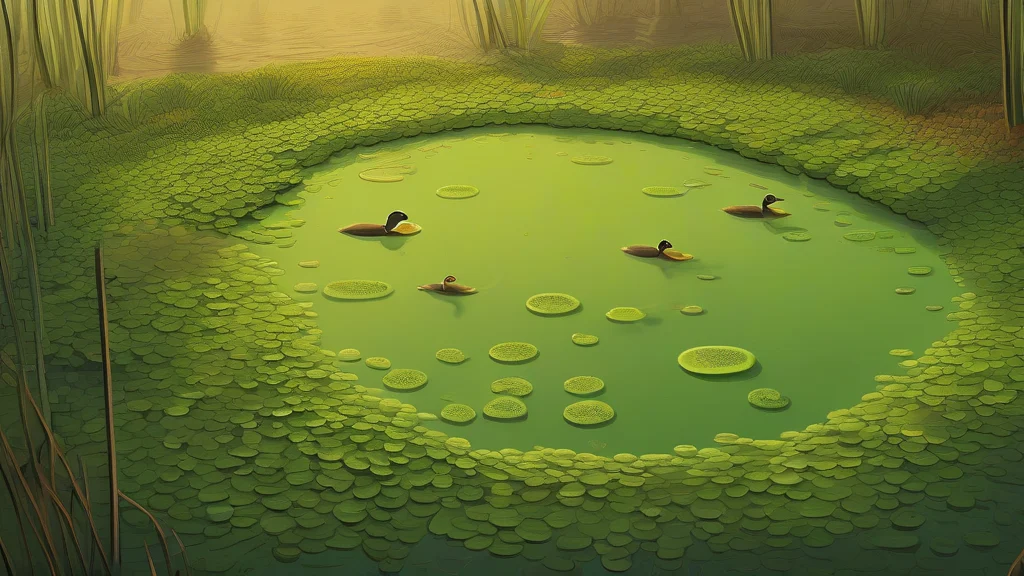
Duckweed is a noun denoting any of several very small floating aquatic plants belonging to the subfamily Lemnoideae of the arum family, found on ponds, lakes, and slow-moving streams throughout the world. The name refers collectively to these plants, which spread rapidly across calm water to form dense green carpets or films that can obscure the surface entirely. In everyday usage, duckweed appears most often in descriptions of natural scenery, gardening, and ecology, where it is noted both as a nuisance that shades out other life and as a valuable habitat and food source for waterfowl — the origin of its name. Beyond nature writing, duckweed has gained attention in environmental science because it grows extraordinarily fast and shows promise for wastewater treatment, biofuel production, and high-protein animal feed. The word carries a neutral, descriptive tone with no figurative or idiomatic extensions.
nounAny of various tiny floating aquatic plants of the family Araceae (formerly Lemnaceae), especially of the genera Lemna, Spirodela, and Wolffia, that form dense green mats on the surface of still or slow-moving fresh water.
- A small floating freshwater plant of the duckweed family (Lemnoideae) that forms dense green mats on still or slow-moving water.
"By late summer the pond was hidden beneath a thick carpet of duckweed."
"The heron picked its way carefully across the duckweed at the edge of the marsh."
"Researchers are investigating duckweed as a fast-growing source of protein for animal feed."
Typically used as an uncountable noun for the collective growth; the plural appears chiefly in botanical contexts when referring to different species.
"Several species of duckweeds grow in this wetland reserve."
Duckweed includes Wolffia — the smallest flowering plant on Earth, at under a millimetre long — and some species can double their mass in just a couple of days.
Reviewed by Deb Chak, Editor. AI-assisted content curated by RJS Tech Solutions LLP.
Etymology of duckweed
The word duckweed is formed from the compound of 'duck' and 'weed', reflecting the fact that ducks readily eat these plants, and it dates from around the sixteenth century in English. It belongs to the large Germanic family of compounds built on 'weed', such as seaweed, ragweed, and bindweed. Because it is an English native compound rather than a borrowing from Latin or Greek, it lacks classical cognates, though the scientific name Lemna comes from the Greek 'lemna', meaning water plant.
Related word forms
How duckweed is actually used
Duckweed is an uncountable noun when referring to the plants collectively as a mat or layer, though it also takes a standard plural 'duckweeds' when referring to individual species. It appears mainly in botanical, ecological, and nature-writing contexts and carries no figurative or idiomatic use.
Easily confused with duckweed
A duckboard is a slatted wooden walkway laid over wet ground, whereas duckweed is a tiny floating water plant.