What does dump mean?
Dump is one of those bluntly useful English verbs that covers everything from dropping a heavy load to ending a relationship without ceremony. At its core it suggests a lack of care: you dump rubbish in a bin, dump files onto a desk, or dump an unwanted task on a colleague. The noun form names both the literal site where garbage accumulates — a dump or rubbish tip — and, informally, any shabby or disorderly place, as in "this room is a dump." The word also appears in technical registers, where a data or core dump records the state of computer memory. Emotionally, dumping implies abruptness; being dumped rarely feels gentle. A related expression, "down in the dumps," describes feeling gloomy. Short, forceful, and slightly unpolished, dump is a word whose sound matches its sense — heavy, sudden, and unsentimental.
To put down, deposit, or discard something heavily, carelessly, or abruptly.
"He dumped his backpack by the door and collapsed on the sofa."
Often implies haste, indifference, or lack of consideration for where something lands.
To end a romantic relationship with someone, typically suddenly and without much tact.
"I can't believe she dumped him by text message."
Strictly informal register.
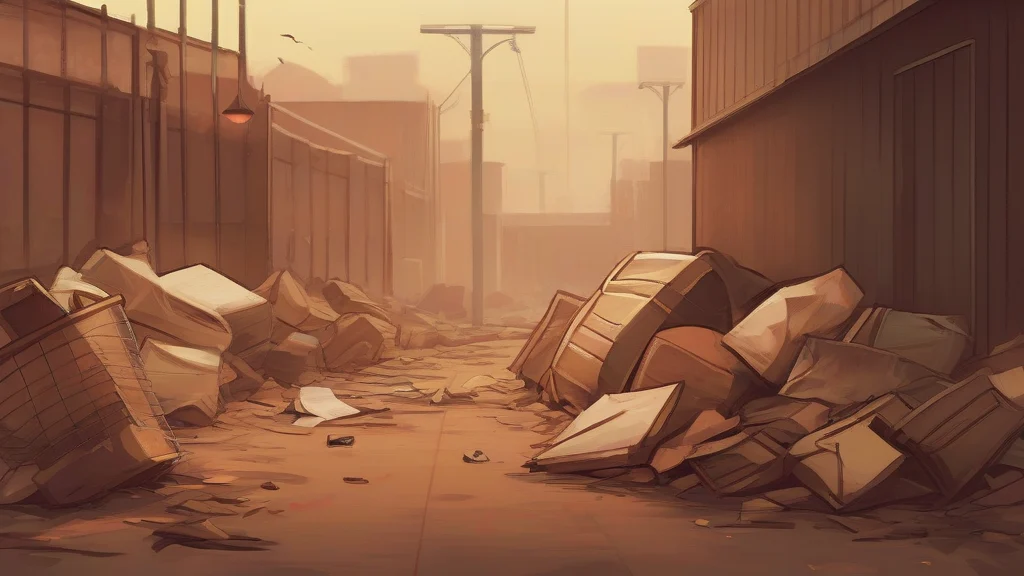
A site where rubbish or refuse is deposited; a landfill or tip.
"The old dump outside town has been converted into a recycling centre."
(informal) An untidy, run-down, or otherwise unpleasant place.
"That hotel was an absolute dump — we checked out after one night."
The plural "dumps" survives chiefly in the fixed expression "down in the dumps," meaning dejected or miserable. Otherwise the singular "dump" is standard.
"He's been down in the dumps ever since he lost his job."
The word "dumps" has meant a fit of melancholy since the 16th century — which is why feeling sad still leaves you "down in the dumps."
Reviewed by Deb Chak, Editor. AI-assisted content curated by RJS Tech Solutions LLP.
Etymology of dump
The verb "dump" first appears in English around the early 16th century, likely of Scandinavian origin, related to Norwegian "dumpa" meaning to thump or fall suddenly. The noun followed shortly after, naming both a heap of refuse and the act of discarding. Its sound symbolism — short vowel plus plosive consonants — gives it an onomatopoeic heaviness that suits its meaning. Related forms include "dumpy" (short and stout) and "dumps" (a state of gloom), the latter giving rise to the idiom "down in the dumps."
Related word forms
How dump is actually used
Informal in most uses; "to dump" a partner carries a connotation of callousness or abruptness. In computing, "a dump" refers to a record of memory contents at a given moment (e.g., core dump), a specialized technical sense.
Easily confused with dump
"Dupe" means to deceive someone, while "dump" means to discard or unload something.