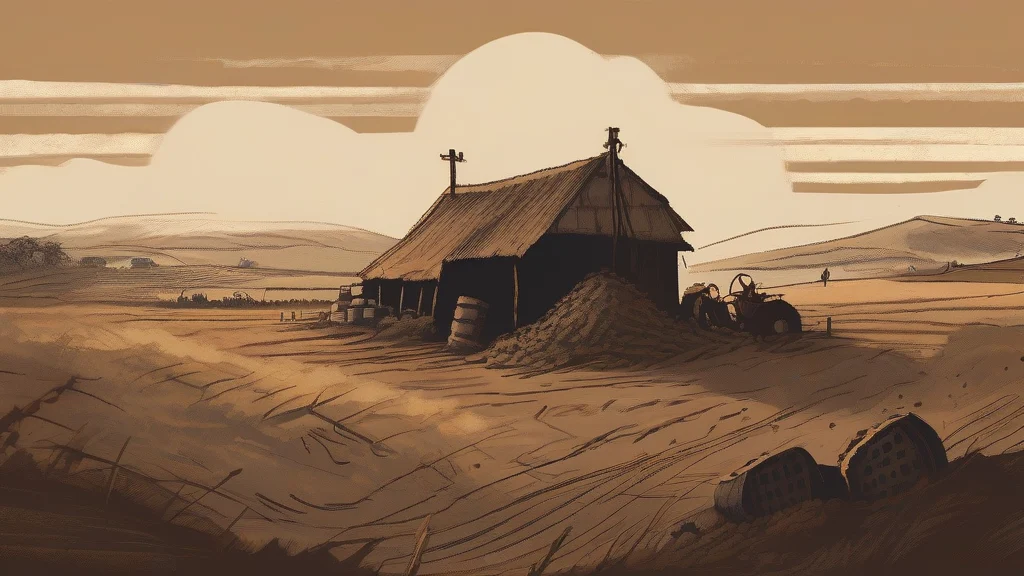
What does dunghill mean?
A dunghill is a heap of animal dung and farmyard refuse, traditionally piled up near stables or barns before being spread on fields as fertiliser. The word combines 'dung', the Old English term for manure, with 'hill', reflecting the mound-like shape such piles take. Once an unremarkable feature of rural life, the dunghill has largely vanished from modern farming, so its literal use now sounds rustic or dated. More durable is its figurative sense: because dung is the very emblem of filth, calling a place or institution a 'dunghill' brands it as squalid, corrupt, or morally base — a usage found in Shakespeare, the Bible's King James translation ('He hath brought down them that sit on high... and hath set them on the dunghill'), and later polemical writing. The word is therefore useful both as a precise piece of agricultural vocabulary and as a vivid, forceful term of condemnation in formal or literary English.
nounA heap of dung, especially one collected from a stable, farmyard, or other place where animals are kept. Figuratively, it denotes something regarded as filthy, worthless, or contemptible.
- A heap or pile of animal dung and refuse, typically on a farm.
- (Figurative) Something regarded as filthy, base, or worthless.
"The farmer forked the fresh straw and manure onto the dunghill behind the barn."
"Chickens scratched about the dunghill at the edge of the yard."
"The report exposed the ministry as a dunghill of petty corruption."
Regular plural formation by adding -s.
"Several dunghills dotted the smallholding, each one carefully turned through the winter."
Shakespeare used 'dunghill' as an insult more than once — calling someone a dunghill was a genuinely cutting way to say they were worthless filth.
Reviewed by Deb Chak, Editor. AI-assisted content curated by RJS Tech Solutions LLP.
Etymology of dunghill
The word 'dunghill' is formed from two Old English elements: 'dung' (manure, excrement) and 'hyll' (hill), making it a straightforward Middle English compound describing a mound of manure. It was in common use by the late medieval period and appears in early printed texts, including the Wycliffite Bible and Shakespeare. Cognate compounds using 'dung' exist across Germanic languages, reflecting the shared Old Germanic root of the word.
How dunghill is actually used
The literal sense is chiefly rural and somewhat old-fashioned in modern speech, as mechanised farming has largely eliminated open dung heaps. The figurative sense carries strong negative connotation of squalor or moral baseness and appears mostly in literary or rhetorical contexts.
Easily confused with dunghill
Dunghill and dungheap are near-synonyms for a pile of manure; 'dungheap' is somewhat more common in British English, while 'dunghill' is the older and more widely recognised form.