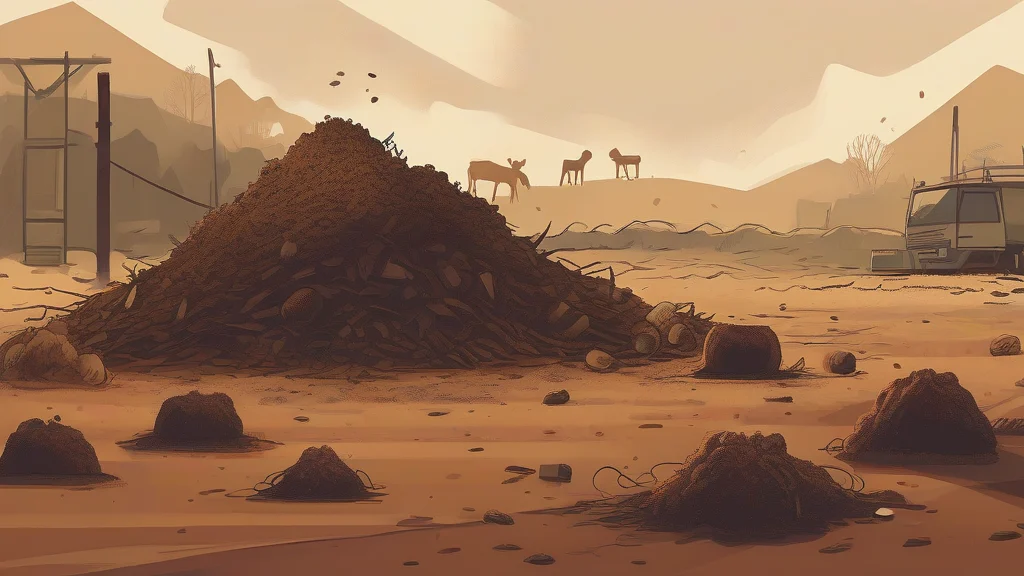
What does dungheap mean?
A dungheap is a heap or pile of animal dung — typically collected from stables, byres, or farmyards and left to rot down before being spread on fields as manure. The word combines 'dung', an Old English term for animal excrement, with 'heap', denoting an accumulated mass. In agricultural communities the dungheap was once a familiar and even essential feature of the farmyard, valued as a source of fertiliser long before synthetic alternatives existed. Today the literal sense survives mainly in historical, literary, or rural contexts, while the word's figurative use has become its more prominent register: to call something a dungheap is to condemn it emphatically as filthy, corrupt, or worthless, as in describing a town reduced to a dungheap of misrule. Because of these strong negative connotations, the term should be used carefully; it is vivid and forceful but unambiguously insulting when applied to people, institutions, or places.
A heap or pile of animal dung, especially one collected for eventual use as manure.
"The dungheap steamed gently in the cold morning air behind the cattle shed."
(Figurative) Something considered filthy, degraded, or utterly worthless.
"Critics dismissed the administration as a dungheap of broken promises."
Regular plural formation; used when referring to multiple heaps of dung, whether literally or figuratively.
"The valley was dotted with dungheaps outside every farmhouse."
In medieval towns the local dungheap was often a landmark — and sometimes literally where citizens were ordered to dump their refuse.
Reviewed by Deb Chak, Editor. AI-assisted content curated by RJS Tech Solutions LLP.
Etymology of dungheap
Dungheap is a compound of two native Germanic elements: 'dung', from Old English 'dung' meaning manure or excrement (cognate with Old Frisian and Old Norse forms), and 'heap', from Old English 'hēap' meaning a pile or mass. The compound arose in English, likely during the Middle English period, as an agricultural term for accumulated manure. It shares its first element with related words such as 'dunghill' and 'dung beetle'.
How dungheap is actually used
The literal agricultural sense is now somewhat old-fashioned or rural in tone; modern usage is more often figurative and strongly pejorative. The word carries connotations of filth and moral degradation when used metaphorically.
Easily confused with dungheap
Both denote a heap of animal waste, but 'dungheap' specifically emphasizes the piled mass itself, while 'dunghill' is the more common term and can also refer to the ground or place where such a heap sits.