What does dunlin mean?
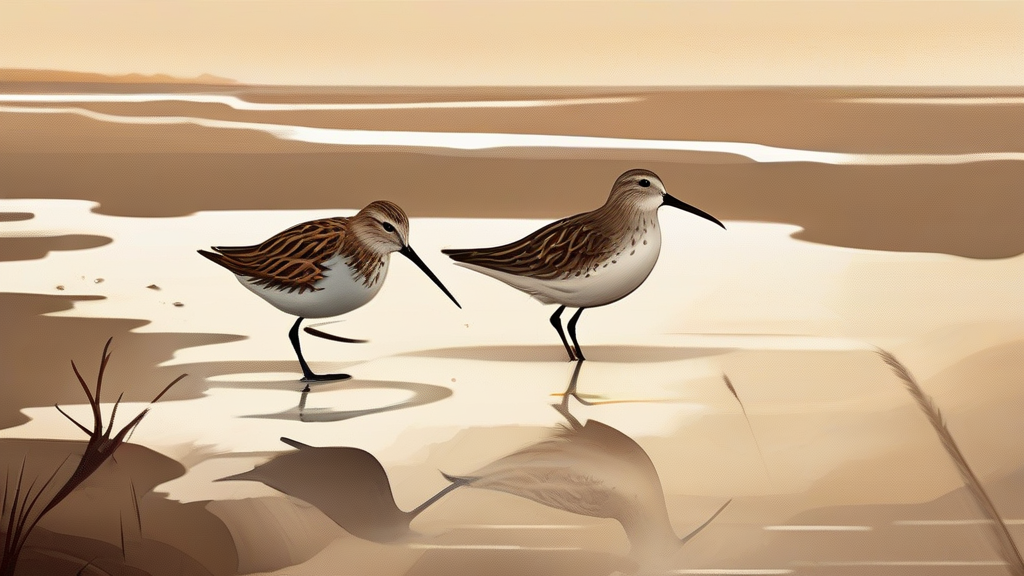
The dunlin is a small, highly abundant wading bird of the sandpiper family, known scientifically as Calidris alpina. Barely larger than a sparrow, it has a slender, slightly downcurved bill that it uses to probe mud and sand for worms, crustaceans, and insects. Dunlins breed across the Arctic and subarctic tundra of North America and Eurasia, then migrate in vast numbers to temperate coastlines for the winter, where they gather in dense flocks on estuaries and mudflats. These flocks are famous among birdwatchers for their tightly coordinated aerial displays, in which thousands of birds wheel together and appear to flash between dark and light as they turn. In breeding plumage the dunlin is especially striking, sporting a rich reddish-brown back and a bold black patch on the belly. The name derives from the colour 'dun' — a dull greyish brown — combined with a diminutive suffix. The word belongs chiefly to ornithological and birding contexts.
nounA small migratory shorebird (Calidris alpina) of the sandpiper family, breeding in Arctic and subarctic regions and wintering on temperate coasts, with a slightly downcurved bill and, in breeding plumage, a distinctive black belly.
- A small Arctic-breeding sandpiper (Calidris alpina) with a downcurved bill, common on coastal mudflats outside the breeding season.
"Thousands of dunlins wheeled over the mudflats in tight, shimmering flocks at high tide."
"A lone dunlin probed the wet sand for worms at the edge of the lagoon."
"In summer plumage, the dunlin's black belly makes it easy to tell from its wintering companions."
The regular plural 'dunlins' is standard when referring to multiple birds; the singular may be used collectively when discussing the species as a whole.
"Murmurations of dunlins darken the sky above the estuary each autumn."
When a dunlin flock twists in flight, thousands of birds flash from grey to white in an instant — a spectacle birders call a 'murumuration' of the mudflats.
Reviewed by Deb Chak, Editor. AI-assisted content curated by RJS Tech Solutions LLP.
Etymology of dunlin
The word 'dunlin' first appears in English around the late sixteenth or early seventeenth century. It combines 'dun', an old English word for a dull greyish-brown colour, with the diminutive suffix '-lin', yielding the sense of a small brownish bird. The same 'dun' root survives in other bird names, notably 'dunnock', another small, plain-coloured species. The name reflects the bird's drab winter plumage, which is what most observers see on coastal mudflats.
How dunlin is actually used
A technical or specialist term used mainly by birders and ornithologists rather than in everyday speech; always refers to the bird, never used figuratively.
Easily confused with dunlin
A dunnock is a small hedge-dwelling songbird (Prunella modularis), whereas a dunlin is a coastal wading bird.
The sanderling is a similar small shorebird that runs along the water's edge and lacks the dunlin's downcurved bill and black breeding belly.