What does ecarte mean?
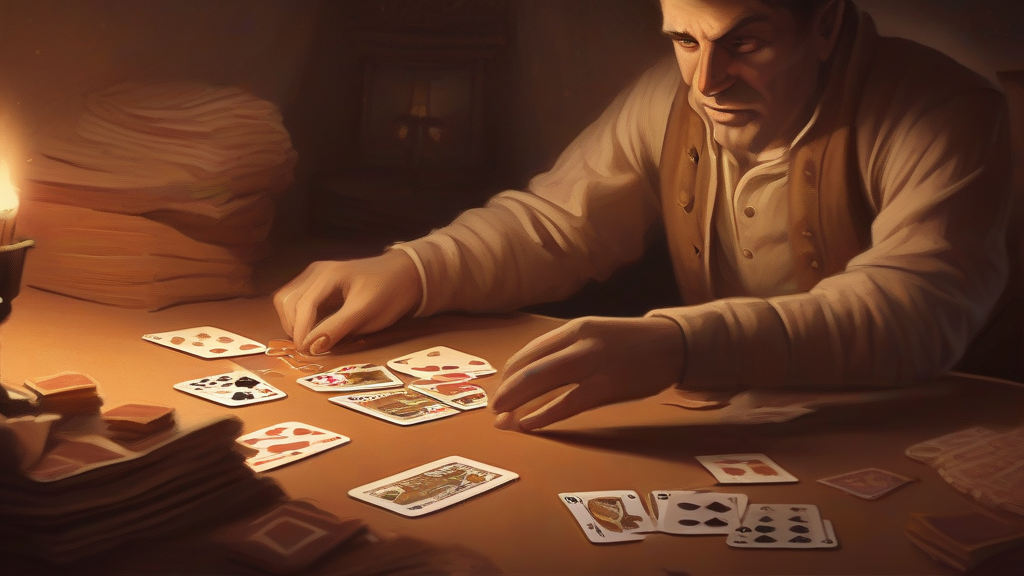
Ecarte is a noun with two distinct senses, both borrowed from French. Its primary historical sense denotes a fast-moving card game for two players, played with a reduced 32-card deck stripped of low cards, in which players gain points by winning tricks and by declaring a 'marriage' — holding the king and queen of the trump suit together. Wildly fashionable in France and England during the nineteenth century, it has since faded into obscurity and now survives mostly in literature set in that era. The word's second, more current sense belongs to classical ballet: an ecarte is a pose in which the dancer's legs extend wide apart, one forward and one back, the name literally suggesting something 'spread apart.' Both senses retain an elegant, continental air. Because the word is rare outside these specialized domains, writers typically deploy it for atmosphere — evoking candlelit gaming tables or the disciplined geometry of the ballet studio — rather than in everyday conversation.
A card game for two players, using a 32-card deck, scored through tricks and declarations of a marriage in the trump suit; popular in nineteenth-century Europe.
"After supper they settled down to a rubber of ecarte by lamplight."
Often italicized as a French loanword, especially in older texts.
In classical ballet, a pose in which the legs are extended wide apart, one toward the front and one toward the back of the body.
"Her ecarte was praised for its clean lines and effortless extension."
Technical dance vocabulary, frequently written with French diacritics (écarté) in ballet contexts.
Rarely pluralized; when referring to multiple games, phrases such as 'games of ecarte' are more natural than 'ecartes.'
"They played several games of ecarte before midnight."
Before poker took over the salons of 19th-century Europe, ecarte was the card game of choice — so fashionable that it gave English the phrase 'on the cards.'
Reviewed by Deb Chak, Editor. AI-assisted content curated by RJS Tech Solutions LLP.
Etymology of ecarte
Ecarte comes directly from French écarté, the past participle of écarter, meaning 'to discard' or 'set apart,' formed from the prefix é- plus carte, 'card' — ultimately from Latin charta, 'leaf of paper.' The card game took its name from the act of discarding cards, which is central to its play. The word entered English during the early nineteenth century, coinciding with the game's surge in popularity across Europe. It shares its root with related borrowings such as discard, cartouche, and placard.
How ecarte is actually used
Both senses carry a distinctly refined, old-world flavor. The card game sense appears chiefly in historical or literary contexts, as the game itself has largely fallen out of play; it is often italicized when treated as a foreign borrowing. The ballet sense is technical vocabulary within dance and may also appear with French diacritics (écarté).
Easily confused with ecarte
An eclair is a pastry filled with cream, whereas ecarte is a two-player card game or a ballet position; the words merely share a French beginning.
Escargot is an edible snail, while ecarte is a card game or ballet position.