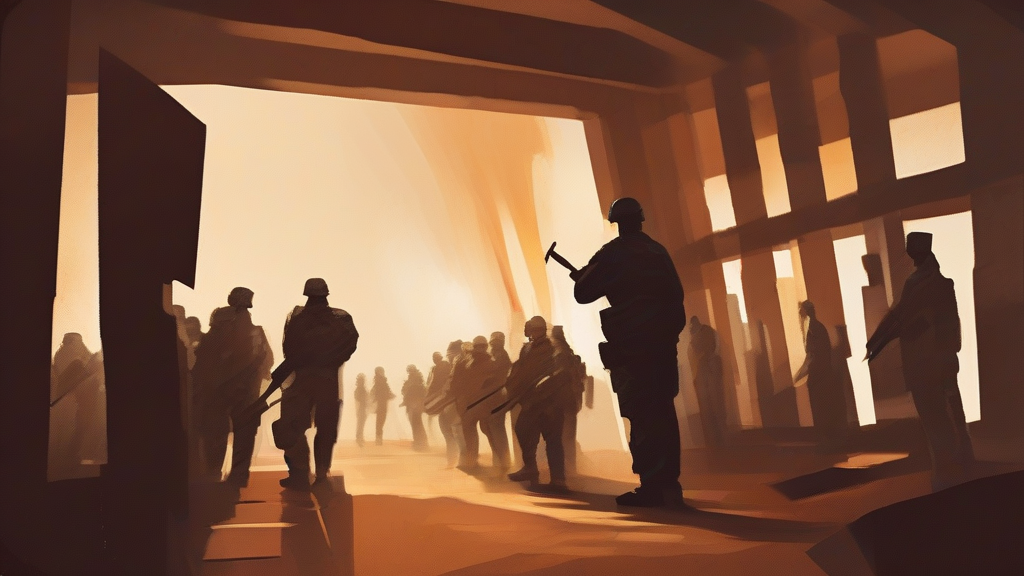
What does echeloning mean?
Echeloning is the practice of arranging units, resources, or activities in successive parallel lines or staggered layers rather than side by side. Its most established home is military language, where it describes positioning troops, tanks, ships, or aircraft at varying depths so that each element can support, reinforce, or relieve the next. By extension, the word appears in aviation, logistics, and management, describing the deliberate staging of departures, deliveries, or workloads in graded phases. The term derives from the French échelle, meaning ladder, evoking the image of rungs set one above another. Echeloning carries a connotation of deliberate planning and disciplined coordination; it implies that separation in time or space is purposeful, not accidental. It remains a formal, largely technical word, valued where precision about layered arrangement matters.
nounThe arrangement of troops, vehicles, aircraft, or units in successive parallel lines or staggered formations so that each can support or relieve the one ahead; more broadly, the arrangement of people, tasks, or things in graded levels or stages.
- The arrangement of military units in successive parallel lines or staggered depth, each echelon positioned to support or relieve another.
- The general arrangement of tasks, resources, or people into graduated levels or sequential stages.
"The tanks advanced in a careful echeloning of armour across the open plain."
"The commander ordered an echeloning of artillery batteries to sustain fire as the infantry advanced."
"The project's echeloning of deadlines kept each team focused on its own stage without overwhelming anyone."
Born on the battlefield, 'echeloning' takes its name from the French word for the rungs of a ladder — soldiers literally climbing levels of attack.
Reviewed by Deb Chak, Editor. AI-assisted content curated by RJS Tech Solutions LLP.
Etymology of echeloning
Echeloning derives from the noun echelon, borrowed into English from French échelon in the late 18th century amid Revolutionary Wars terminology for troop formations. The French word ultimately traces to Old French eschelon, a diminutive of eschele, meaning ladder, from Latin scala. The verb echelon arose from this noun by conversion, and echeloning is its gerund and verbal-noun form.
Related word forms
How echeloning is actually used
Chiefly used in formal and technical registers, especially military doctrine, aviation, logistics, and management writing. In everyday speech the simpler verb 'stagger' is far more common.
Easily confused with echeloning
An echeveria is a succulent plant of the stonecrop family, whereas echeloning refers to arranging forces or items in staggered tiers.