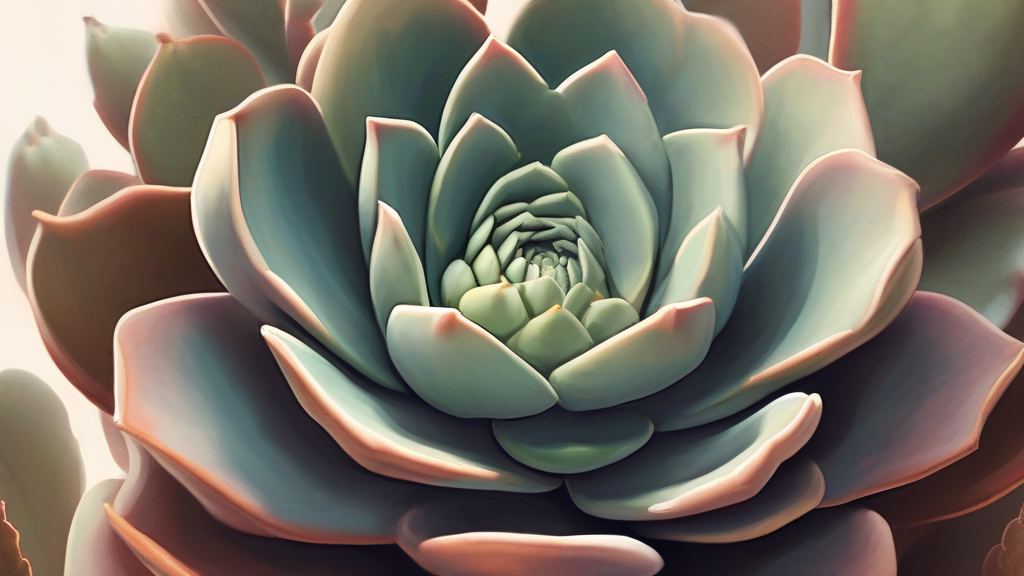
What does echeveria mean?
An echeveria is any plant belonging to the genus Echeveria, a group of succulents native chiefly to Mexico and parts of Central and South America. The plants are best known for their striking rosette form: thick, fleshy leaves arranged in tight spirals, often tinted blue-green, grey, pink, or purple, sometimes with a powdery coating that protects them from intense sun. Because they store water in their leaves, echeverias tolerate drought well and have become enormously popular as low-maintenance houseplants and as architectural accents in gardens and floral design. They prefer bright light, gritty free-draining soil, and infrequent watering, and are easily propagated from individual leaves. In everyday usage the word appears almost exclusively in gardening, horticulture, and interior-design writing, typically in the plural when describing collections of the plants.
nounA genus of succulent plants native to the semi-desert regions of Central America, particularly Mexico, characterized by rosettes of thick, fleshy leaves, often grown as ornamental houseplants.
- Any plant of the genus Echeveria; a succulent forming dense rosettes of fleshy leaves, widely cultivated as an ornamental.
"A cluster of echeverias lined the sunny windowsill, their pale blue-green rosettes catching the morning light."
"The florist tucked a few echeverias between the roses to give the bouquet a modern sculptural look."
"Echeverias thrive on neglect, needing little more than bright light and the occasional watering."
In botanical Latin the plural may be rendered 'echeveriae', but ordinary English usage strongly favors 'echeverias'.
"Dozens of echeverias filled the greenhouse benches at the succulent show."
Every echeveria you've ever seen traces its name back to a Mexican botanical illustrator of the 1700s — Atanasio Echeverría — whose drawings were so good the plant got his name.
Reviewed by Deb Chak, Editor. AI-assisted content curated by RJS Tech Solutions LLP.
Etymology of echeveria
The name Echeveria honors Atanasio Echeverría, an eighteenth-century Mexican botanical artist who contributed illustrations to the Flora Mexicana expedition led by Spanish naturalists Martín Sessé and José Mariano Mociño. The genus was formally named in his honor by Swiss botanist Augustin Pyramus de Candolle in the early nineteenth century. As a modern Latin generic name it has no English cognates, though it entered general horticultural vocabulary alongside many other New World succulent names during the Victorian plant-collecting era.
Related word forms
How echeveria is actually used
Used mainly in gardening and horticultural contexts. Plural is usually 'echeverias'; the Latinized plural 'echeveriae' also occurs in botanical writing.
Easily confused with echeveria
Sempervivum (houseleek) is a hardy outdoor succulent with similar rosette forms but belongs to a different genus and tolerates frost far better than echeveria.