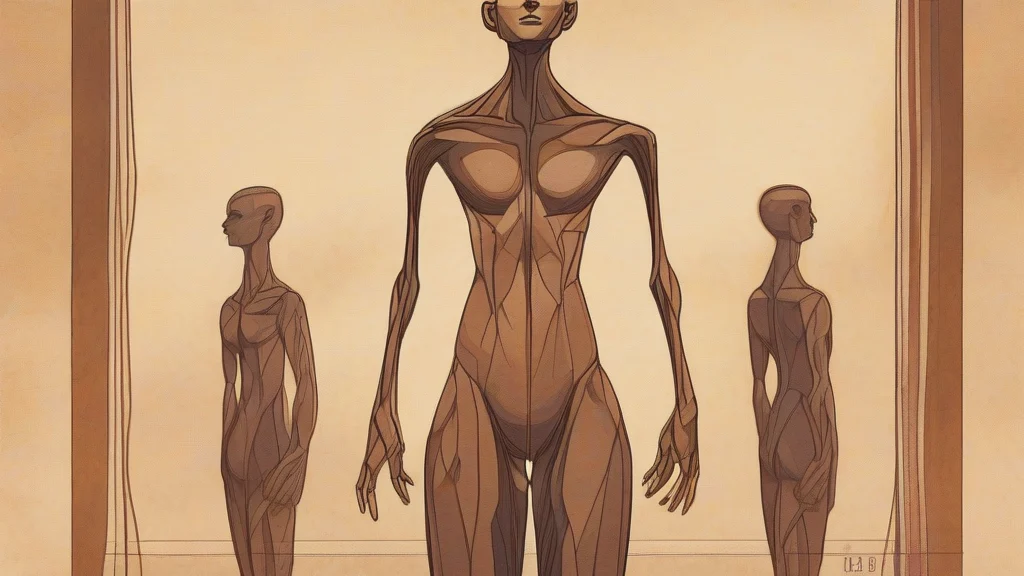
What does ectomorphy mean?
Ectomorphy is a noun describing a body type marked by slenderness: long limbs, a light frame, and relatively little muscle or fat. It comes from the somatotype system devised by American psychologist William Sheldon in the 1940s, which classified physiques along three dimensions — endomorphy (roundness), mesomorphy (muscularity), and ectomorphy (linearity) — named for embryonic germ layers. In contemporary usage the word survives mainly in fitness, sports science, and anatomy writing, where it characterizes people who find it hard to gain weight or build bulk. Although Sheldon linked body types to personality traits, his theory has been thoroughly discredited, and the word now carries no such implication; it simply names a lean, delicate build. Related forms include 'ectomorph', for a person of this type, and the adjective 'ectomorphic'. The term remains useful where precision matters more than everyday phrasing.
nounThe physical condition or body type characterized by a slim, lightly built frame with long limbs and low muscle and fat mass; in constitutional psychology, one of the three somatotypes described by William Sheldon.
- A slim, linear body build with long limbs and little muscle or fat (the dominant modern sense, used in fitness and anatomy contexts).
- In Sheldon's now-historical typology of human physiques, the component or trait measuring predominance of ectodermal characteristics such as thinness and delicacy.
"His pronounced ectomorphy made him a natural fit for distance running, though he struggled to add muscle at the gym."
"Years of basketball honed her natural ectomorphy into genuine athletic ability."
"Sheldon's rating system scored each person on scales of endomorphy, mesomorphy, and ectomorphy."
Rarely pluralized; the uncountable form is standard except when comparing distinct instances or degrees of the body type across individuals.
"The study compared the ectomorphies of elite marathoners across several countries."
Coined in the 1940s by a psychologist who ranked bodies on three numbered scales, ectomorphy turned 'skinny' into a scientific-sounding somatotype — and its creator's system is now largely discredited.
Reviewed by Deb Chak, Editor. AI-assisted content curated by RJS Tech Solutions LLP.
Etymology of ectomorphy
Ectomorphy combines two Greek elements: 'ektos', meaning 'outside', and 'morphē', meaning 'form' or 'shape'. The term was coined by American psychologist William H. Sheldon in his 1940 book 'The Varieties of Human Physique', as part of his three-component system of somatotypes. Sheldon drew the names from the three embryonic germ layers — endoderm, mesoderm, and ectoderm — mapping each bodily dimension onto a layer associated with a type of tissue. The same Greek roots appear in many English words, including 'ectoderm', 'ectoplasm', 'morphology', and 'amorphous'.
Related word forms
How ectomorphy is actually used
A technical term found chiefly in fitness writing, anatomy, and discussions of historical constitutional psychology. It is neutral in register but can sound clinical or dated in casual conversation, where words like 'slim' or 'lean' are more natural. Sheldon's somatotype theory, from which the word derives much of its currency, has been widely discredited, so use of the term today usually implies no acceptance of that theory's claims about personality.
Easily confused with ectomorphy
Ectopia refers to an organ or body part situated in an abnormal position, whereas ectomorphy describes a naturally slim body build.