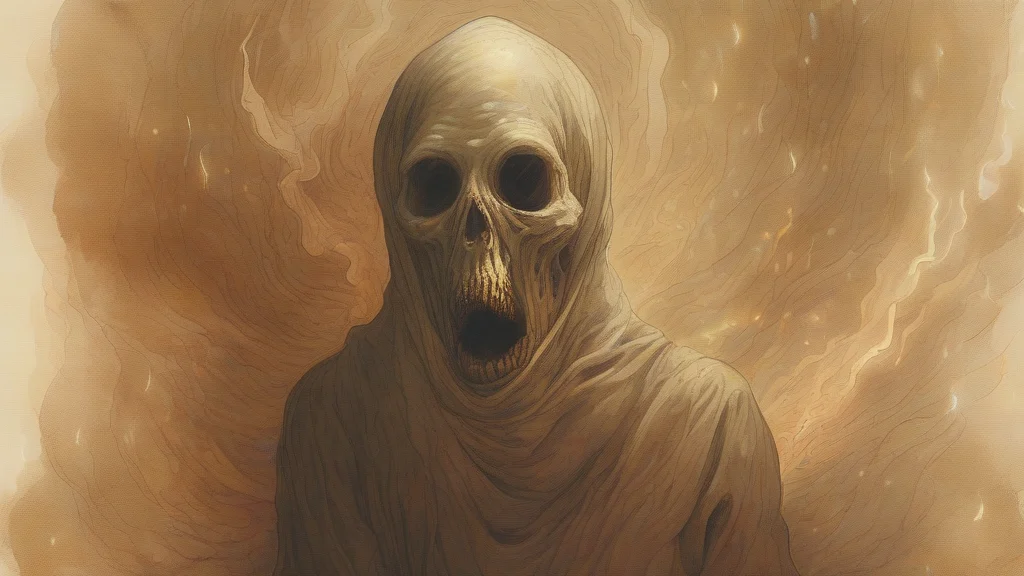
What does ectoplasm mean?
Ectoplasm refers to a substance that spiritualists in the late nineteenth and early twentieth centuries claimed emanated from the body of a medium during a trance. Believers described it as a whitish, viscous material that emerged from the mouth, nose, or other orifices and then formed the shapes of spirits, faces, or objects visible to sitters at séances. The term was coined around the 1890s by the French physiologist Charles Richet, drawing on Greek roots meaning 'outside' and 'something moulded.' Investigations repeatedly revealed that supposed ectoplasm was ordinary fabric, paper, or other props concealed by fraudulent mediums, so the word today is used almost exclusively with reference to the history of spiritualism, in skeptical discussion of paranormal claims, or humorously in fiction and film about ghosts. A second, unrelated sense survives in biology, where ectoplasm denotes the clear outer layer of cytoplasm in cells such as amoebae. The word strongly evokes the occult and the séance-room atmosphere of the Victorian and interwar periods.
A substance of unknown nature supposedly exuded from a spiritualist medium during trance and believed to form the material basis of physical manifestations of spirits.
"Investigators found the 'ectoplasm' to be nothing more than muslin stuffed into the medium's sleeve."
Almost always used historically, skeptically, or humorously, as genuine belief in ectoplasm has faded.
In biology: the outer, relatively clear layer of cytoplasm in an amoeba or similar cell, distinguished from the granular inner endoplasm.
"The ectoplasm of the amoeba flows forward to form the pseudopodium."
Technical term, chiefly found in older cytological literature.
Usually uncountable when referring to the substance itself; the plural appears mainly when discussing different alleged specimens or instances.
"Early investigators collected samples they claimed were different ectoplasms from several mediums."
The word was coined by a Nobel Prize-winning physiologist — Charles Richet — who believed it explained how spirits took physical form at Victorian séances.
Reviewed by Deb Chak, Editor. AI-assisted content curated by RJS Tech Solutions LLP.
Etymology of ectoplasm
Ectoplasm was coined in the early 1890s by French physiologist Charles Richet, who combined the Greek prefix 'ekto-' (outside) with 'plasma' (something moulded or formed). It entered English shortly after, via translations of French spiritist literature. The word shares its Greek root 'plassein' (to form or mould) with plasma, protoplasm, and plastic, while its prefix relates to words like ectoderm.
Related word forms
How ectoplasm is actually used
The spiritualist sense is now used almost exclusively in historical, skeptical, or humorous contexts, since alleged ectoplasm was repeatedly exposed as fraud (typically cloth or gauze hidden by the medium). The biological sense is technical and largely confined to older cytology texts describing amoeboid movement. The word carries strong connotations of the occult, the Victorian era, and popular ghost imagery.
Easily confused with ectoplasm
Protoplasm is the living substance inside biological cells, whereas ectoplasm is either the supposed spiritualistic substance or the clear outer layer of cytoplasm.
Ectoderm is the outermost embryonic germ layer that develops into skin and nervous tissue; ectoplasm has no developmental meaning.