What does eelgrass mean?
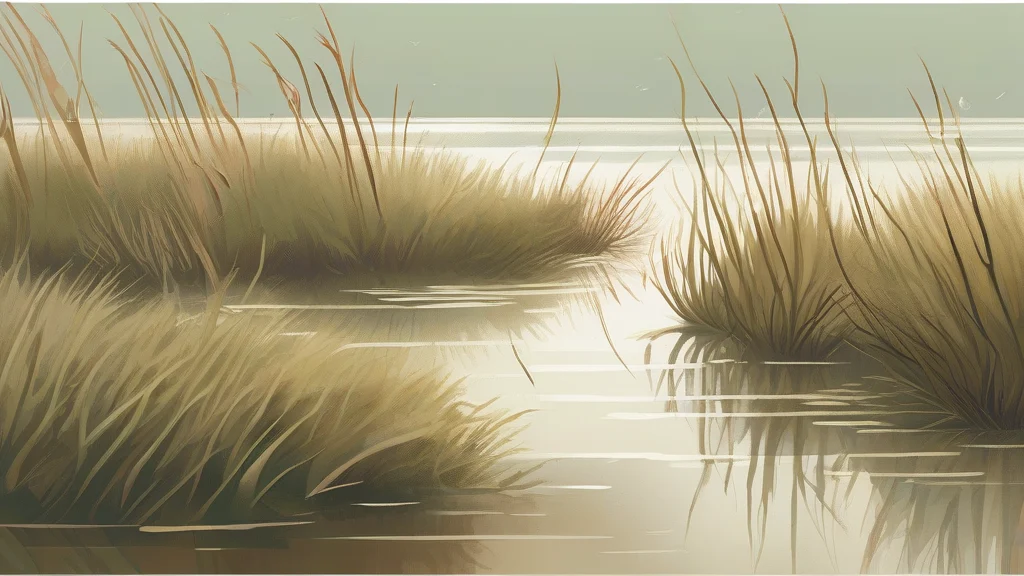
Eelgrass is a noun denoting a marine flowering plant of the genus Zostera, most commonly Zostera marina, which thrives in shallow, temperate coastal waters where its long, ribbon-like leaves sway beneath the surface like blades of an underwater lawn. Despite its grass-like appearance, it is a true flowering plant that blooms, pollinates, and sets seed entirely underwater — a rarity among plants. The name derives from the resemblance of its slender leaves to eels. Eelgrass forms extensive beds and meadows that rank among the most productive ecosystems on earth: they stabilize sediment, absorb carbon, filter nutrients, and serve as critical nursery habitat for fish, crabs, scallops, and waterfowl such as brant geese, which graze on it heavily. Because these meadows have declined sharply due to pollution, dredging, and warming seas, 'eelgrass' appears frequently today in environmental science and conservation writing, often alongside terms like 'restoration' and 'bed.' It is a specialized rather than colloquial word, valued for its precision in ecological contexts.
nounA submerged marine flowering plant of the genus Zostera, especially Zostera marina, which grows in meadows on sandy or muddy seabeds in temperate coastal waters and has long, ribbon-like green leaves.
- The marine flowering plant Zostera marina, common in temperate northern hemisphere coastal waters.
- Any of various related seagrasses of the genus Zostera or, more loosely, similar ribbon-leaved aquatic plants.
"The bay's eelgrass meadows provide nursery habitat for young fish and shellfish."
"Conservationists replanted eelgrass along the shoreline to restore the estuary's natural filtration."
"Migrating brant geese feed almost entirely on eelgrass during their coastal stopovers."
Usually treated as a mass noun when referring to the vegetation collectively; the plural 'eelgrasses' appears mainly in botanical writing referring to multiple species.
"Several eelgrasses occur along the Atlantic coast, each favoring slightly different conditions."
Eelgrass isn't a seaweed at all — it's one of the few plants that truly flower underwater, and its meadows can shelter thousands of sea creatures per square metre.
Reviewed by Deb Chak, Editor. AI-assisted content curated by RJS Tech Solutions LLP.
Etymology of eelgrass
The word eelgrass is a straightforward English compound formed from 'eel,' referring to the long, sinuous shape of the plant's leaves, and 'grass,' reflecting its grass-like habit. Both elements are of Old English origin ('ēl' or similar for eel; 'græs' for grass). The compound has been used since at least the early modern period to describe Zostera marina and similar ribbon-leaved aquatic plants, and related names appear in other European languages describing the same eel-like leaf form.
How eelgrass is actually used
A chiefly scientific, ecological, and conservation term rather than everyday vocabulary; in casual speech people often say simply 'seagrass.' In North American usage it may occasionally be applied to freshwater ribbon-leaved plants such as Vallisneria, though botanists restrict it to Zostera.
Easily confused with eelgrass
Seagrass is a general term for all marine flowering grasses, whereas eelgrass refers specifically to species of the genus Zostera.