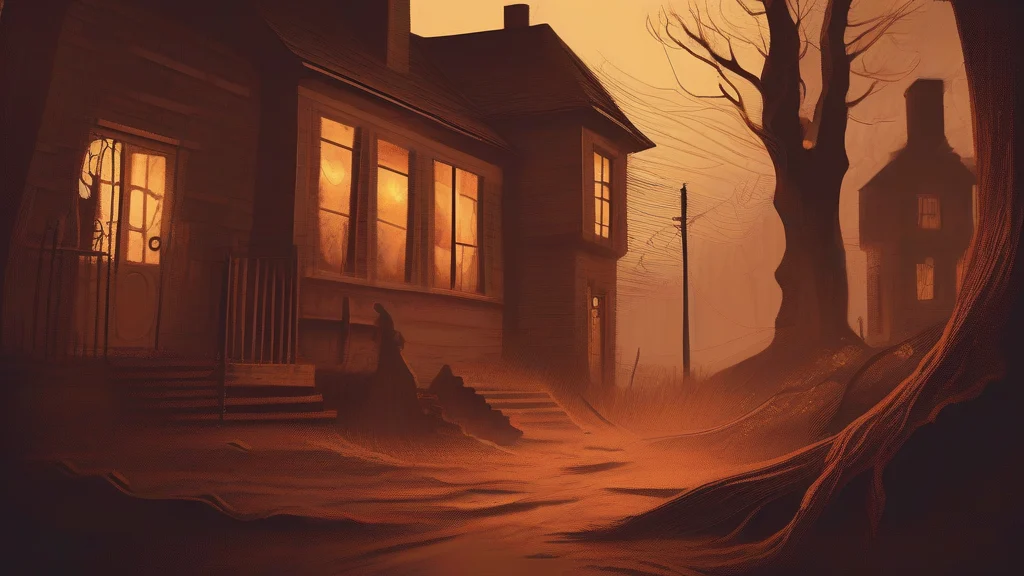
What does eerie mean?
Eerie is an adjective describing something strange and mysterious in a way that provokes a quiet, creeping sense of fear — the feeling that something uncanny or supernatural might be at work. An empty street at midnight can be eerie; so can a flickering light, a sudden hush, or a coincidence too exact to dismiss. The word's power lies in its vagueness: it does not name a specific danger but captures an atmosphere of unexplained unease, which makes it a staple of ghost stories, horror fiction, and everyday speech alike. It commonly pairs with nouns such as silence, glow, calm, and feeling. Interestingly, eerie has not always meant what it does now. It derives from the Old English 'earg', meaning timid or cowardly, and for centuries it referred to fearful people rather than frightening places. Only in northern English and Scottish dialects did it gradually shift to describe the dread itself, before spreading into general English by the eighteenth and nineteenth centuries. Its derivatives include the adverb 'eerily' and the noun 'eeriness'.
So strange as to inspire a feeling of mysterious fear or unease; suggestive of the supernatural.
"An eerie green light pulsed beneath the surface of the loch."
Most often used attributively before nouns denoting sounds, lights, silences, places, or sensations.
(Chiefly Scots and northern English dialect) Fearful, timorous, or timid — the older sense of the word.
"In old Scots verse, a hero might be mocked as eerie for shrinking from battle."
This sense is now rare outside dialect and historical literature.
Before 'eerie' ever meant spooky, it meant cowardly — Old English 'earg' described someone too timid to fight, and only over centuries did its meaning drift from fearful people to frightening places.
Reviewed by Deb Chak, Editor. AI-assisted content curated by RJS Tech Solutions LLP.
Etymology of eerie
Eerie descends from Old English 'earg', meaning cowardly, timid, or fearful, which is related to Old High German 'arg' (wicked) and shares a Germanic root with words like 'argue' via Latin 'arguere'. In northern English and Scots dialects the word survived after falling out of standard use, and there its sense shifted from 'fearful' (describing a person) to 'causing fear' (describing a place or atmosphere). By roughly the eighteenth century, largely through Scottish literary usage, 'eerie' had entered broader English with its modern sense of mysteriously frightening or uncanny.
Related word forms
How eerie is actually used
Eerie carries a connotation of vague, atmospheric dread rather than overt terror — it describes the unsettling mood of a scene or sensation rather than an explicit threat. It is common in both literary and everyday register, especially in descriptions of ghost stories, horror films, abandoned places, and coincidences. It frequently appears before nouns describing light, sound, silence, and feelings.
Easily confused with eerie
'Eery' is simply an older variant spelling of the same word; modern standard spelling is 'eerie', so they mean exactly the same thing.