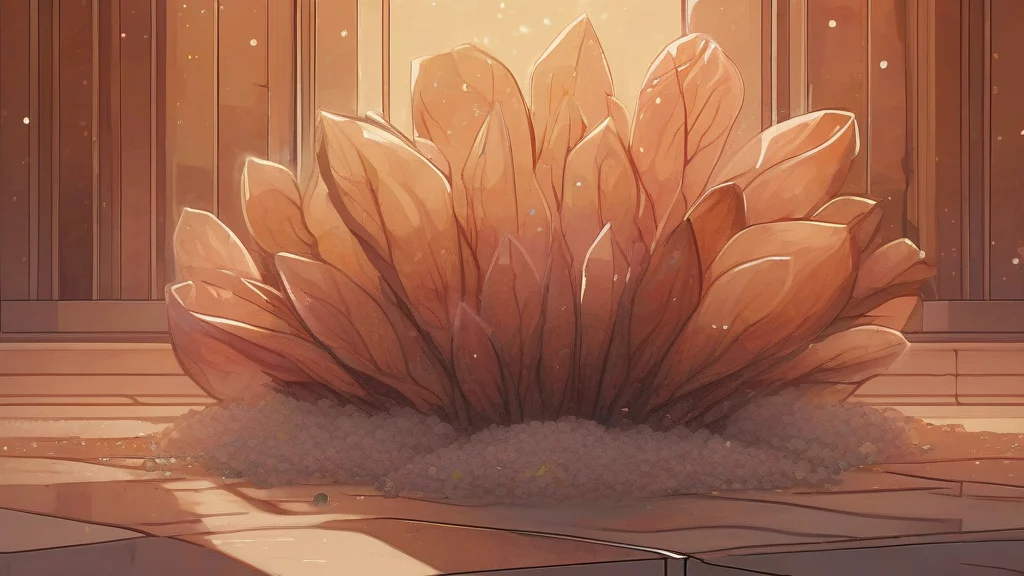
What does efflorescing mean?
Efflorescing is the present participle of the verb effloresce, meaning to bloom or burst into flower, and by extension to flourish or reach full development. In its most frequent modern sense, it describes a chemical process: the formation of a powdery, often whitish crystalline deposit on the surface of brick, concrete, stone, or other porous materials as moisture within them evaporates and leaves dissolved salts behind. Builders, conservators, and chemists routinely speak of walls or masonry efflorescing when this telltale bloom appears, since it signals water moving through the material. The word derives from the Latin efflorescere, combining ex- ('out') with florescere ('to begin to flower'), so its imagery of blossoming runs through both senses. Though its figurative use — describing ideas, cultures, or artistic styles efflorescing into their fullest expression — survives mainly in elevated prose, the term remains precise, vivid, and indispensable wherever blooming, whether botanical or chemical, needs an exact name.
(present participle of effloresce) To form a powdery crystalline deposit on a surface as moisture evaporates; or, more rarely, to bloom or flourish.
"Salt was efflorescing along the base of the garden wall after weeks of rain followed by dry heat."
Describing something that is blooming, flourishing, or forming a crystalline surface deposit.
"The efflorescing salts gave the tunnel wall a pale, dusty bloom."
Adjectival use is less common than verbal use; 'efflorescent' is generally preferred as the adjective.
That chalky white powder creeping up old brick walls has a name — and it comes from the Latin for 'to burst into flower.'
Reviewed by Deb Chak, Editor. AI-assisted content curated by RJS Tech Solutions LLP.
Etymology of efflorescing
Efflorescing comes from the Latin verb efflorescere, formed from ex- ('out of') plus florescere ('to begin to flower'), itself from flos ('flower'). The word entered English in the early 17th century, first in the literal botanical sense of bursting into bloom, before extending figuratively to any flourishing or unfolding. The chemical sense — salts forming a powdery surface crust as moisture escapes — developed later, drawing on the same image of something flowering forth from within. Cognates sharing the root include florescence, florid, floral, flourish, and efflorescence.
Related word forms
How efflorescing is actually used
In modern usage, 'efflorescing' is most at home in technical registers — chemistry, building conservation, and materials science — where it describes salt deposits on porous surfaces. The literal botanical sense ('bursting into bloom') and figurative senses are now largely literary and somewhat rare; writers usually prefer simpler words like 'blooming' or 'flourishing' outside technical contexts.
Easily confused with efflorescing
Evanescing means fading away or vanishing, nearly the opposite of efflorescing's sense of blooming or emerging into view.