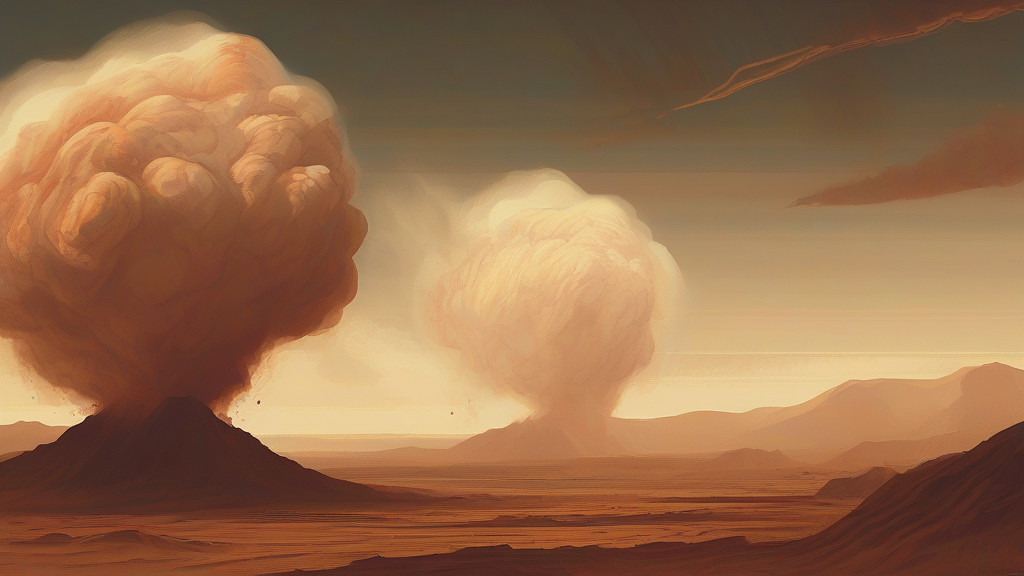
What does ejecta mean?
Ejecta refers to material that is forcibly thrown out of a source such as a volcano or an impact crater, and it is used almost exclusively as a technical term in geology and planetary science. In volcanology, ejecta encompasses everything a volcano expels — ash, cinders, pumice, and larger volcanic bombs — while in impact studies it describes the rock and dust blasted outward when a meteorite strikes a surface. The word functions as a plural noun: one speaks of ejecta being scattered, deposited, or sampled, rather than treating it as a singular mass. Scientists commonly pair it with words like "blanket," referring to the layer of debris that surrounds a crater, and "deposit," describing where that material settles. Because it appears frequently in reports of eruptions and in studies of the Moon, Mars, and other bodies, ejecta is a valuable word for anyone reading about natural disasters or space exploration, even though it rarely surfaces in casual conversation.
nounMaterial that is thrown out or forcibly discharged, especially solid matter expelled by a volcano or debris blasted from an impact crater during a meteorite strike. It is a plural noun used chiefly in geology and planetary science.
- Solid matter ejected from a volcano, such as ash, cinders, and volcanic bombs.
- Debris thrown out from an impact crater formed by a meteorite or other high-velocity collision.
"The astronauts collected samples of the crater's ejecta to study the Moon's impact history."
"Volcanic ejecta rained down on villages several miles from the summit."
"Analysis of the ejecta revealed minerals consistent with a massive meteorite impact."
"The Apollo missions returned samples of lunar ejecta for laboratory study."
Ejecta is already plural and takes plural verbs; it has no widely accepted singular form, so writers avoid constructions requiring one.
"The ejecta from the eruption were deposited over an area of hundreds of square kilometres."
The dust scattered around lunar craters is called ejecta — and it has been sitting untouched on the Moon for billions of years.
Reviewed by Deb Chak, Editor. AI-assisted content curated by RJS Tech Solutions LLP.
Etymology of ejecta
Ejecta comes directly from Latin ejectus, the past participle of eicere, meaning "to throw out," formed from ex- ("out") and iacere ("to throw"). The same Latin root gives English a family of related words, including ejection, inject, projectile, and conjecture. The term was adopted into scientific English in the 19th century as geologists formalized their vocabulary for volcanic and later impact-related phenomena.
How ejecta is actually used
Ejecta is a plural noun with no common singular form; it takes plural agreement ("the ejecta were scattered"). It belongs mainly to technical registers — volcanology, planetary science, and geology — and would sound overly formal in everyday speech, where "debris" or "material thrown out" would be more natural.
Easily confused with ejecta
"Eject" is the verb meaning to force something out, while "ejecta" is the noun for the material that has been thrown out.