
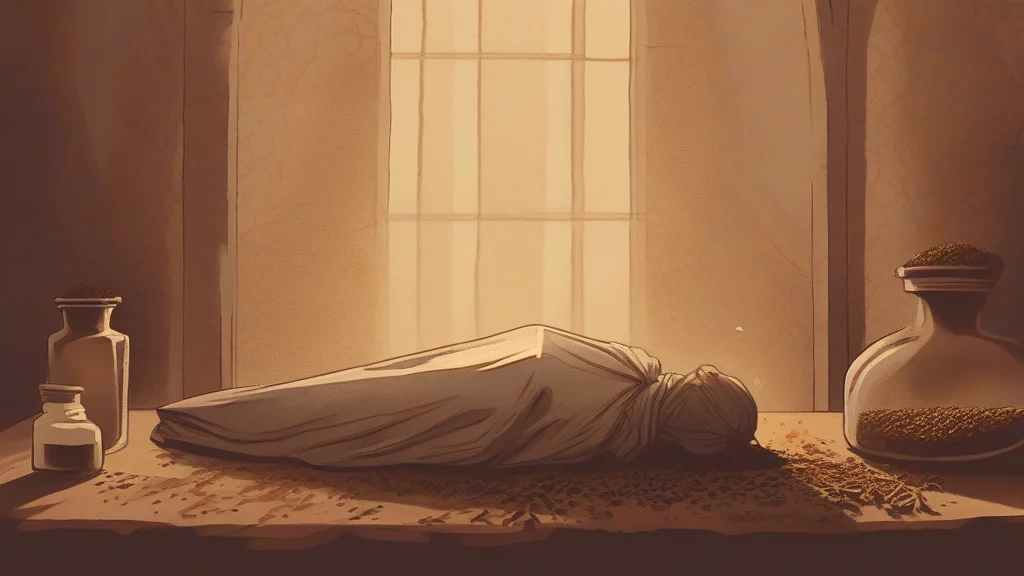
What does embalmment mean?
Embalmment is the process of preserving a dead body by treating it with aromatic substances or chemical preservatives so that it resists decay. The term applies both to modern mortuary science, where formaldehyde-based fluids are injected into the circulatory system, and to ancient practices such as Egyptian mummification, in which resins, natron, and linen were used to prepare bodies for the afterlife. By extension, embalmment can describe the figurative preservation of anything — a memory, a tradition, or an institution — kept deliberately unchanged, often with a hint of stiffness or artificiality. The word derives from 'embalm,' rooted in 'balsam,' referring to the fragrant resins once prized for their preservative qualities. Formal in register, it appears chiefly in historical, archaeological, and literary writing rather than everyday speech, where 'embalming' is preferred.
The act or process of preserving a dead body with preservatives to prevent decay.
"The museum's exhibit traced the history of embalmment from ancient Egypt to Victorian mourning customs."
Often used in historical or anthropological discussion; 'embalming' is the usual term in contemporary funeral-service contexts.
Figuratively, the preservation of something in an unchanged or static state.
"Critics accused the committee of preferring the embalmment of old traditions to genuine reform."
Rarely used; the noun is almost always uncountable when referring to the process, and even countable uses typically appear in the singular.
"The tombs yielded evidence of embalmments performed over several dynasties."
The word 'embalm' originally meant 'to apply balm' — the same fragrant resins that soothed the living were believed to preserve the dead for eternity.
Reviewed by Deb Chak, Editor. AI-assisted content curated by RJS Tech Solutions LLP.
Etymology of embalmment
Embalmment comes from the verb 'embalm,' formed from the prefix 'em-' (from Latin in-, via Old French) plus 'balm,' which entered Middle English through Old French basme/baume from Latin balsamum, ultimately from Greek balsamon — likely borrowed from a Semitic source. The original sense was literally 'to apply balm,' reflecting the use of fragrant resins and spices in treating corpses, famously by the ancient Egyptians. The noun 'embalmment' arose in English by suffixing '-ment,' with attestations dating from around the early modern period.
Related word forms
How embalmment is actually used
A formal, somewhat literary noun. In modern mortuary practice the gerund 'embalming' is far more common than 'embalmment'; the latter tends to appear in historical, religious, or figurative contexts. The plural 'embalmments' is rare and generally avoided.
Easily confused with embalmment
Entombment means placing a body in a tomb, whereas embalmment is the chemical preservation of a body before burial.