
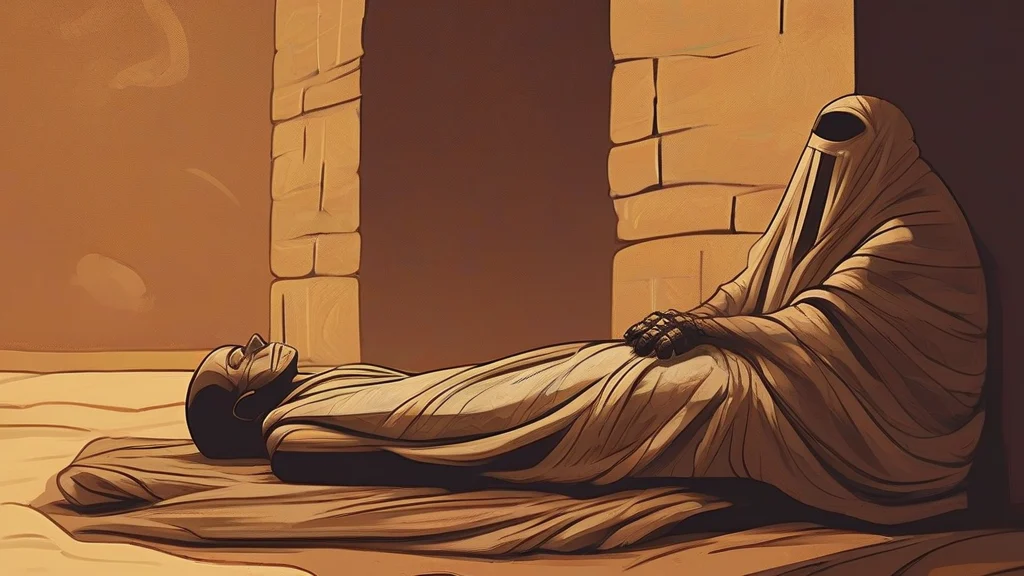
What does mummification mean?
Mummification is the preservation of a dead body, particularly through a process that dries or otherwise treats it so that ordinary decomposition is slowed or prevented. Its best-known historical setting is ancient Egypt, where embalmers prepared bodies for burial and belief in the afterlife, although similar techniques were used in other cultures and natural mummification occurs in exceptionally dry environments. The word can also describe the accidental or incidental transformation of remains into a dry, shrivelled state. In modern usage, it is usually a specialist term associated with archaeology, medicine, forensic science, and museums. Its associations with death and bodily decay make it occasionally unsuitable for casual contexts, but it remains a precise and evocative word for describing how a dead body is preserved from the normal processes of decomposition.
nounThe process of preserving a dead body by drying it or otherwise treating it to prevent decomposition, especially through embalming. The term also refers to the condition of a body that has undergone this process.
- The deliberate preservation of a dead body, especially by embalming and drying.
- The natural or incidental drying and shrivelling of a dead body until it resembles a mummy.
"The museum's exhibition explains the mummification of humans and animals in ancient Egypt."
"Mummification was practiced in ancient Egypt as a way to preserve the body for the afterlife."
"The unusually dry climate allowed the body to undergo natural mummification without artificial treatment."
Normally used when referring to separate bodies or historical examples that have undergone the process.
"The collection includes mummifications of humans and animals from several ancient cultures."
Mummification can preserve a human body for thousands of years, turning a life into a lasting physical trace.
Reviewed by Deb Chak, Editor. AI-assisted content curated by RJS Tech Solutions LLP.
Where does mummification come from?
Mummification was formed in English in the early 17th century from “mummify” plus the suffix “-ation.” Those forms ultimately connect with “mummy,” which entered English through French and derives from Arabic mummiya, meaning “embalmed body.” The related English verb “mummify” retains the same historical sense of preserving a corpse through embalming or drying.
How mummification is actually used
The word is chiefly technical, historical, or archaeological and has an inherently macabre association. In medical and forensic contexts, it can describe the natural transformation of remains in very dry conditions.
Easily confused with mummification
Mummification is the noun naming the process, while mummifying is the verb describing the action of carrying it out.