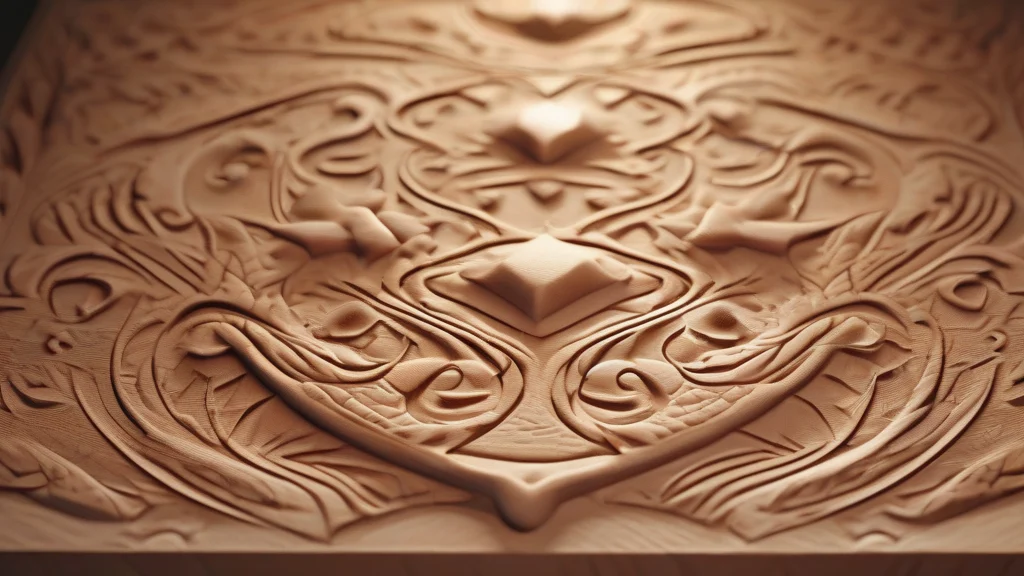
What does emboss mean?
To emboss is to create a design that rises in relief from the surface of a material — whether paper, leather, metal, or fabric — by pressing, stamping, or hammering rather than by cutting into it. The technique appears everywhere from formal wedding invitations bearing a raised monogram, to leather book covers tooled with ornamental patterns, to business cards and official seals where a raised mark signals authenticity. Because the effect is tactile as well as visual, embossing carries connotations of craftsmanship, luxury, and permanence: an embossed detail suggests care and expense that flat printing cannot convey. The word functions mainly as a transitive verb ('she embossed the cover with her initials'), though its past participle 'embossed' works readily as an adjective describing finished goods. A closely related term, 'deboss', describes the opposite — pressing a design inward so it sits below the surface. Emboss remains essential vocabulary in printing, packaging, and the decorative arts.
verbTo carve, mould, or stamp a design onto a surface so that it stands out in relief; to decorate something with a raised pattern or figure.
- To raise a design or pattern on a surface so it stands out in relief, as by hammering from the reverse side or pressing with a die.
- (Of a surface or object) To be decorated with such raised ornamentation.
"The stationer embossed the wedding invitations with a delicate floral border."
"The craftsman embossed the brass plaque with the company's crest."
"Each page of the album was embossed with a subtle geometric pattern."
That raised seal on a fancy invitation isn't just decoration — it's the same craft technique medieval bookbinders used to make leather covers pop.
Reviewed by Deb Chak, Editor. AI-assisted content curated by RJS Tech Solutions LLP.
Etymology of emboss
Emboss derives from French 'embosser', formed from the prefix 'em-' (a variant of Latin 'in-', meaning 'in' or 'on') combined with 'bosse', meaning a bump, swelling, or protuberance. The noun 'bosse' itself likely traces back through Old French to Germanic origins. The English word entered use in the early 17th century, retaining its core sense of producing raised ornamentation. It is related to the noun 'boss' in its older sense of a protuberance or stud, as found in architectural bosses decorating vaulted ceilings.
Related word forms
How emboss is actually used
Typically used in formal or technical contexts relating to printing, bookbinding, leatherwork, metalwork, and graphic design. The past participle 'embossed' is frequently used adjectivally. In Braille production, 'emboss' is the standard verb for producing raised dots on paper.
Easily confused with emboss
Imprint means to press a mark into a surface (leaving it sunken or flat), while emboss specifically means raising the design above the surface in relief.
Engraving cuts lines into a hard surface such as metal or stone, whereas embossing raises the design outward without cutting away material.