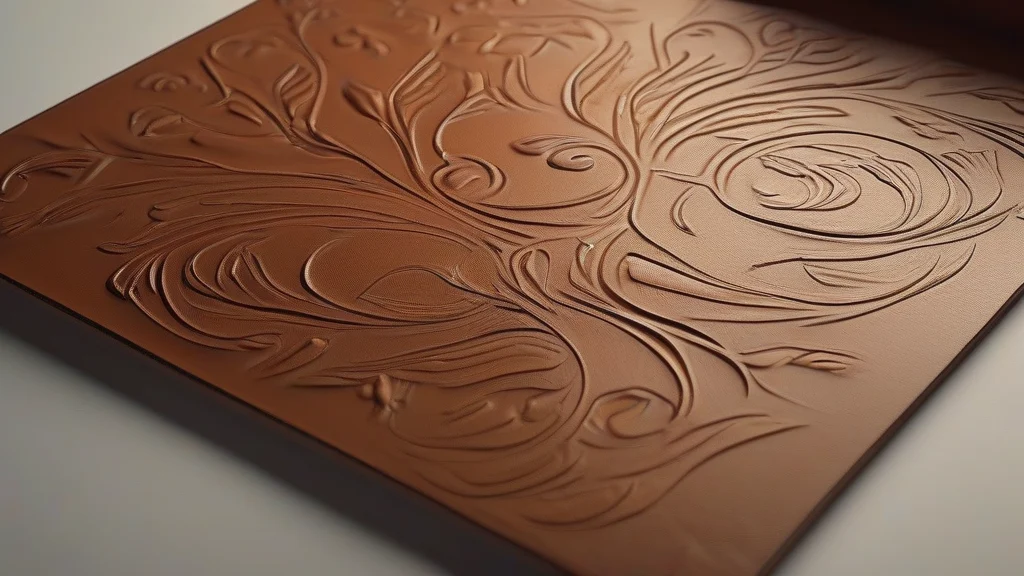
What does embossing mean?
Embossing is the craft of producing a raised design on a surface — most often paper, card, leather, or metal — by applying pressure that pushes the material up from behind or between shaped dies. The result is a decoration you can feel as well as see: a monogram on fine stationery, a seal on a legal document, a pattern tooled into leather, or a motif worked into sheet metal. In printing and stationery, embossing signals quality and formality, which is why it appears on wedding invitations, diplomas, and business cards. Variants include blind embossing, which uses no ink or foil and relies purely on shadow and touch, and combinations with foil for greater visual effect. The word derives from the verb "emboss," ultimately rooted in Old French and Germanic terms for a boss or raised protuberance, reflecting the technique's core idea of lifting a design above its background.
nounThe process or technique of creating a raised design on a surface, typically paper, leather, or metal, by pressing or hammering it from underneath or with a die. It can also refer to the raised decoration produced by this process.
- The craft technique of raising a design on paper, card, leather, or metal by applying pressure from behind or with matched dies.
- A raised decorative pattern or figure produced by this technique.
"The wedding invitations featured elegant gold embossing on heavy cream stock."
"The stationer specialized in blind embossing, which adds texture without any ink or foil."
"The leather craftsman's embossing of the crest gave the wallet a distinctive, tactile finish."
Rarely used; the noun is normally uncountable. A plural may appear when referring to distinct instances of raised decoration on an object.
"The antique chest's brass fittings bore several embossings of heraldic beasts."
That raised seal on a diploma or a wax-sealed letter? That's embossing — a craft so old it was used to decorate medieval armor and still shows up on your credit card.
Reviewed by Deb Chak, Editor. AI-assisted content curated by RJS Tech Solutions LLP.
Etymology of embossing
Embossing derives from the verb "emboss," which entered English from Old French "emboissier," formed from "em-" (in) plus "bosse" (a bump or swelling), a word of Germanic origin. The underlying root is the same that gives us "boss" meaning a raised knob or protuberance, first recorded in English in the late Middle Ages. Originally used of raised ornamentation on metalwork such as armor and vessels, the term broadened with printing and paper crafts to describe raised designs on paper and leather. Its cognates include French "bosse" and related Germanic words for lump or swelling.
Related word forms
How embossing is actually used
"Embossing" is most common in printing, stationery, bookbinding, and craft contexts. "Blind embossing" refers to relief made without ink or foil; when combined with foil it may be called foil embossing. The related term "debossing" denotes the recessed opposite. As a noun it is normally uncountable.
Easily confused with embossing
Debossing presses a design into the surface so it is recessed or indented, whereas embossing raises the design above the surface.