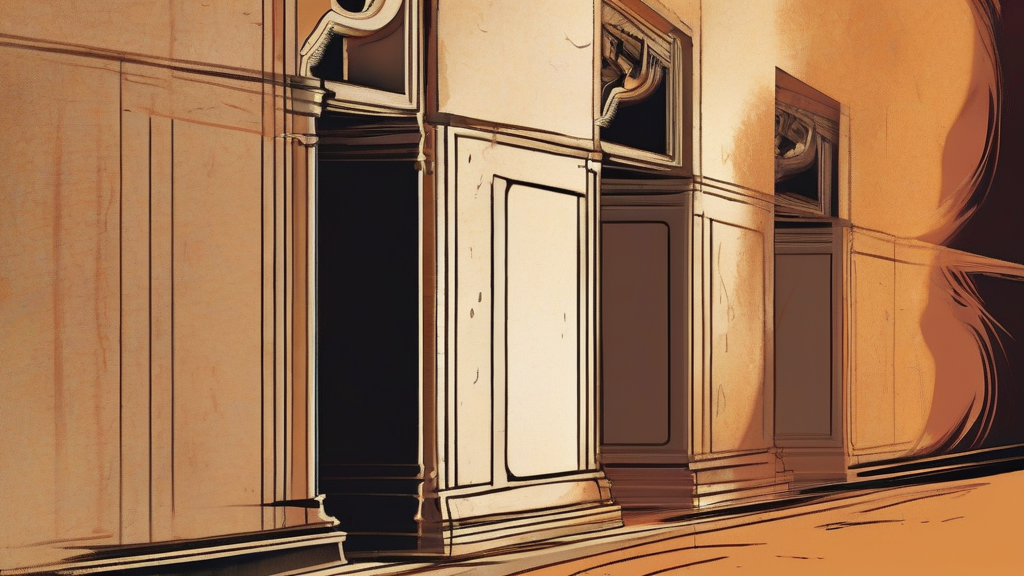
What does embrasure mean?
An embrasure is an opening cut into a wall, most famously the narrow gap in a castle wall through which defenders fired arrows or guns. Its inner sides flare outward — a design called splaying — so that a soldier behind the wall could aim across a wide arc while remaining protected. In civilian architecture, the same word describes the slanted reveal of a window or door set in a thick wall, where the sides of the opening slope inward toward the glass. The term belongs largely to the vocabulary of fortification and architectural history, lending any sentence a precise, slightly antiquarian flavor: writers reach for it when describing battlements, arrow slits, or the deep-set windows of medieval buildings. Derived from French, ultimately from a verb meaning to embrace or clasp, embrasure captures the idea of walls closing around an opening. It remains a specialist but vivid word, useful for anyone describing historic buildings or siege warfare with accuracy.
nounAn opening or splayed recess in a wall for a door or window, especially one widened on the inside of a thick defensive wall to allow a wider field of fire; more broadly, the slanted sides of a window opening in ordinary architecture.
- An opening in a wall or parapet for discharging weapons, with sides splayed to widen the field of fire (fortification).
- The splayed recess or jambs of a window or door opening in a thick wall (architecture).
"She stood in the cool shadow of the embrasure, watching the courtyard below."
"The archers took position at each embrasure along the curtain wall."
"Morning light spilled through the deep embrasure of the Norman window."
Standard regular plural; used when referring to multiple openings along a wall or across a building.
"Loopholes and embrasures punctuated the ramparts at intervals."
The word for a castle's shooting slit comes from the same French verb that gave us 'embrace' — an opening literally 'embraced' by splayed walls.
Reviewed by Deb Chak, Editor. AI-assisted content curated by RJS Tech Solutions LLP.
Etymology of embrasure
Embrasure entered English from French in the early 17th century, during the era when European fortification theory was highly developed. It derives from the French verb embraser, meaning to widen an opening, which traces back through Old French to a root connected with embracing or clasping. The word is thus related etymologically to embrace and to other terms formed on the same Romance base, though its architectural sense developed specifically within the language of military engineering.
How embrasure is actually used
Embrasure is a formal, technical term used chiefly in architectural and military-historical writing. It carries an evocative, old-world connotation and is rare in everyday speech, though it appears in fiction set in castles or historic buildings.
Easily confused with embrasure
A crenellation is the notched parapet along the top of a wall, whereas an embrasure is the opening itself in the wall for firing weapons or admitting light.