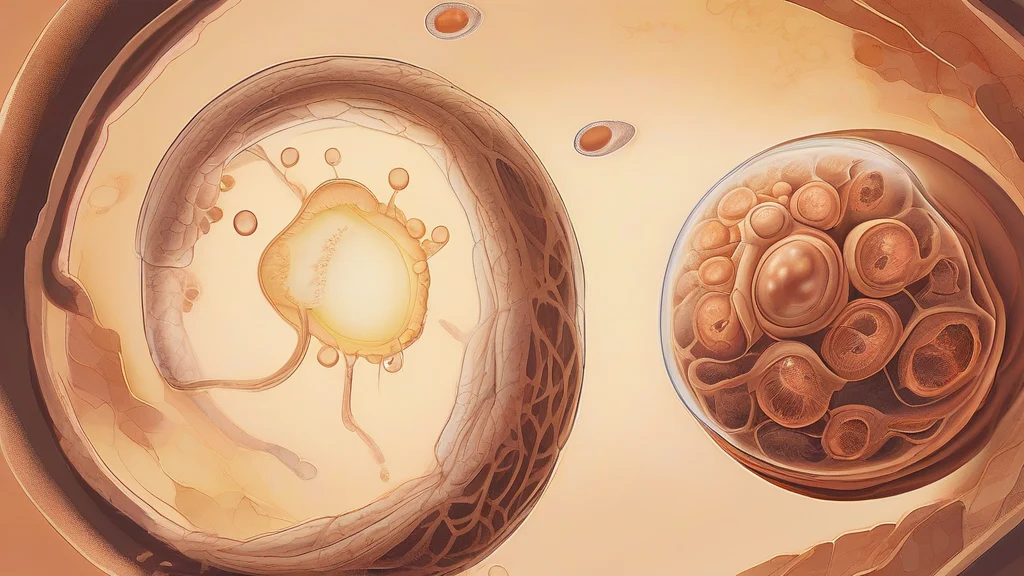
What does embryogenesis mean?
Embryogenesis is the biological process by which an embryo comes into being and develops. In animals, it begins when a sperm fertilizes an egg, triggering rapid cell division, the establishment of the body's basic architecture, and the differentiation of cells into tissues and organs; in flowering plants, it refers to the development of the embryo within the seed. The term is also used in plant biotechnology to describe the remarkable ability of ordinary somatic cells — a leaf cell, say — to be coaxed into forming an entire embryo without any fertilization at all. Strictly technical in register, embryogenesis appears mainly in research papers, textbooks, and medical contexts rather than casual speech. It belongs to a family of terms built on the Greek roots for 'embryo' and 'origin', alongside embryology, which is the study of this process rather than the process itself. Understanding the word is essential reading for anyone approaching developmental biology.
nounThe process by which an embryo forms and develops from a fertilized egg cell (or, in plants, from a zygote or somatic cell) into a multicellular embryo.
- The formation and development of an animal embryo from a fertilized egg.
- The initiation and development of an embryo in seed plants following fertilization.
- The artificial induction of embryo-like structures from somatic (non-reproductive) cells, as in plant tissue culture.
"Researchers observed that temperature shifts during early embryogenesis can alter the development of the vertebral column."
"Calcium signaling plays a crucial role in the earliest stages of mammalian embryogenesis."
"In tissue culture, somatic embryogenesis allows a single plant cell to regenerate into a complete embryo."
Rarely used; the noun is normally uncountable since it names a process. The plural appears chiefly in scientific writing to distinguish multiple instances or pathways of embryo formation.
"The study compared embryogeneses induced by different concentrations of auxin."
In some plants, a single ordinary leaf cell can skip the egg entirely and rebuild a whole new embryo through somatic embryogenesis — no fertilization required.
Reviewed by Deb Chak, Editor. AI-assisted content curated by RJS Tech Solutions LLP.
Etymology of embryogenesis
Embryogenesis combines two Greek roots: 'embryon' (ἔμβρυον), meaning the unborn young or fruit of the womb, and 'genesis' (γένεσις), meaning origin or creation. The compound was formed in the nineteenth century as biology professionalized, joining a wave of '-genesis' terms such as morphogenesis and ontogeny. It shares its second element with words like genetics, generate, and progeny, all ultimately tracing back to the Greek verb 'gignesthai', to come into being.
Related word forms
How embryogenesis is actually used
A formal, technical term used almost exclusively in biology, medicine, and plant science; it would be unusual in everyday conversation. It covers the period from fertilization up to roughly the end of the embryonic stage, after which biologists typically speak of fetal development in animals. In plant science it also has a specialized sense covering somatic (asexual) embryo formation.
Easily confused with embryogenesis
Embryology is the scientific study of embryos and their development, whereas embryogenesis is the developmental process itself.