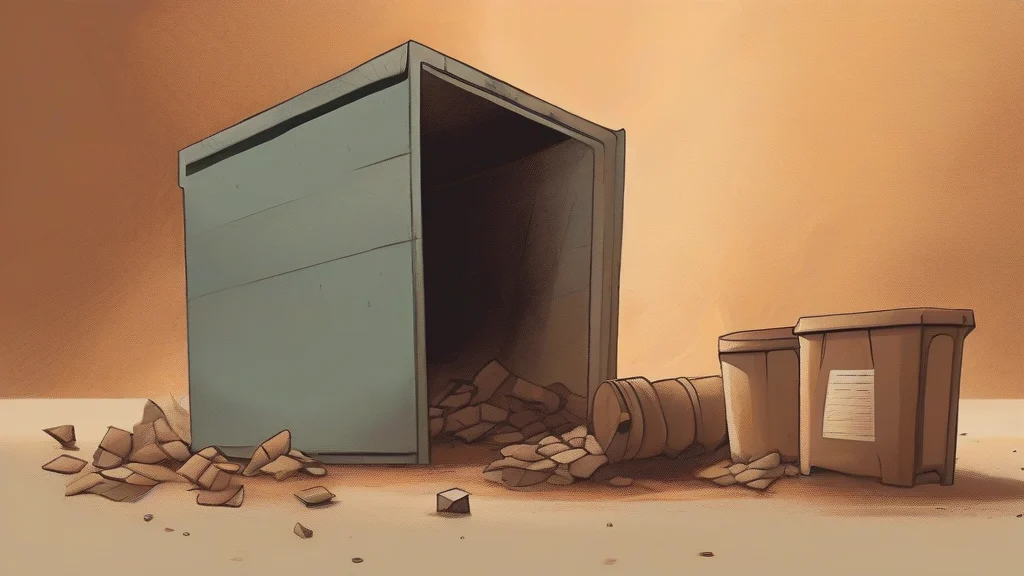
What does emptying mean?
Emptying refers to the act or process of removing the contents from a container, space, or place until nothing remains inside. It functions both as a noun — as in 'the emptying of the pool' — and as the present participle of the verb 'to empty', describing an ongoing action such as 'she was emptying the dishwasher'. The word appears frequently in practical contexts like waste disposal, cleaning, and logistics, but also carries technical weight in medicine, where terms like 'gastric emptying' describe measurable bodily processes. Its connotations are generally neutral and functional, though figurative uses can suggest loss or depletion, as in 'the gradual emptying of rural villages'. Derived from Old English through Middle English roots related to emptiness, the word remains a versatile and precise choice when writers need to describe removal or depletion clearly.
The act or process of removing the contents of something; the state resulting from this process.
"The emptying of the fuel tanks had to be done carefully."
Often used in technical or medical registers.
Present participle of 'empty'; engaged in the action of removing contents.
"He was emptying the bins when I arrived."
Rarely used in the plural; typically only in specialized or archaic contexts referring to multiple instances or types of emptying processes.
"The journal recorded the daily emptyings of the cisterns."
In medicine, 'gastric emptying' is a measurable physiological process — doctors can literally time how fast your stomach empties.
Reviewed by Deb Chak, Editor. AI-assisted content curated by RJS Tech Solutions LLP.
Etymology of emptying
Emptying derives from the verb 'empty', which comes from Middle English 'emty' or 'amety', itself formed from Old English 'ǣmettig' meaning 'at leisure, unoccupied, vacant', from 'ǣmetta' ('leisure, rest'). The suffix '-ing' forms the verbal noun and present participle. Cognate forms appear across Germanic languages, reflecting a common root relating to freedom from occupation or content.
How emptying is actually used
As a gerund/noun it is somewhat formal or technical; in everyday speech people often prefer phrases like 'clearing out' or 'draining'. In medical contexts (e.g. 'bladder emptying', 'gastric emptying') it carries a precise technical sense.
Easily confused with emptying
Emptiness is the state or quality of being empty (often emotional), while emptying is the act or process of making something empty.