What does emu mean?
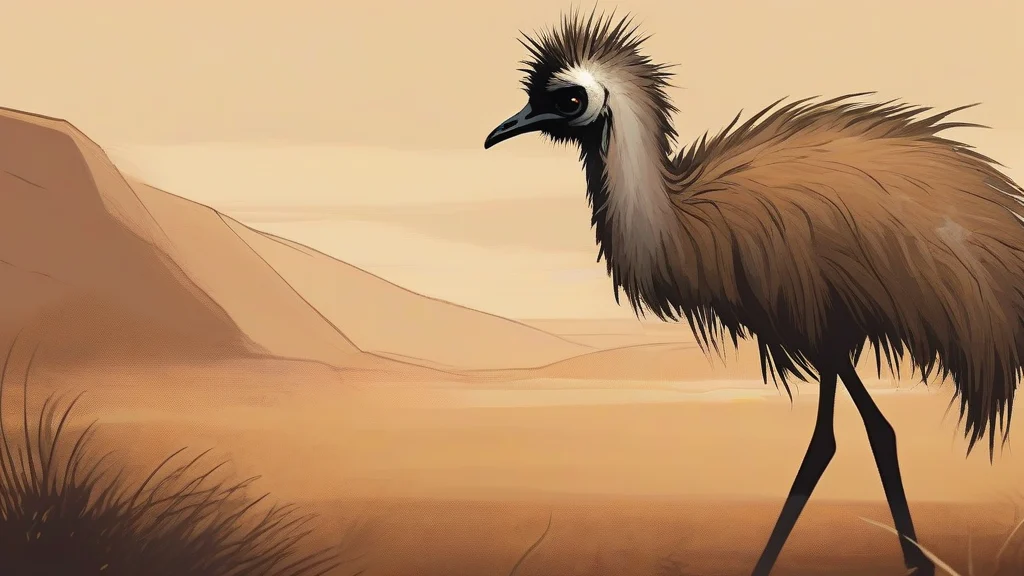
The emu is a large, flightless bird endemic to Australia and is the world's second-tallest living bird, surpassed only by the ostrich. Standing well over a metre tall and covered in shaggy brownish-grey double-shafted feathers, it has a long bare neck, small wings, and powerful legs that allow it to run at remarkable speed across open terrain. Emus are omnivorous, feeding on seeds, fruit, insects, and green shoots, and are notable for their unusual breeding behaviour: the male incubates the dark-green eggs and rears the chicks alone. Beyond natural history, the word appears in commercial contexts — emu oil and emu farming are established industries — and in Australian cultural memory through the famous 1932 'Emu War', a failed military operation against crop-raiding birds. For English speakers, 'emu' is chiefly encountered as a concrete noun naming this distinctive animal.
nounA large, flightless Australian bird with shaggy brown feathers, a long neck, and long legs; the second-tallest living bird after the ostrich. It is also, in Australia, the name of a former monetary unit worth one tenth of a dollar.
- A large flightless Australian ratite bird (Dromaius novaehollandiae) with shaggy brown plumage and long legs.
"The emu sprinted across the outback plain at surprising speed."
"Emus can sprint at up to about 50 kilometres per hour across open country."
"The farmer raised emus for their lean meat and prized oil."
Standard English plural, formed simply by adding -s. Used when referring to multiple individuals of the species.
"Several emus gathered near the waterhole at dusk."
In 1932 Australia deployed soldiers with machine guns against emus — and lost. The 'Emu War' remains history's most famous military defeat by birds.
Reviewed by Deb Chak, Editor. AI-assisted content curated by RJS Tech Solutions LLP.
Etymology of emu
The word 'emu' entered English in the early seventeenth century, borrowed from Portuguese 'ema', meaning crane or large bird, which itself likely derives from Arabic. Portuguese explorers first used the term for large flightless birds they encountered, and it was later applied specifically to the Australian species. It has no true cognates sharing a root in modern English vocabulary.
How emu is actually used
Always capitalized in heraldic contexts referring to specific coats of arms? No — lowercase 'emu' is standard in ordinary use. The word is used both as a common noun and in proper names such as 'Emu War'.
Easily confused with emu
An emu is native to Australia and is the second-largest living bird, whereas an ostrich is larger, native to Africa, and belongs to a different genus.
An emu is a large flightless bird from Australia, while a rhea is a smaller flightless bird from South America.