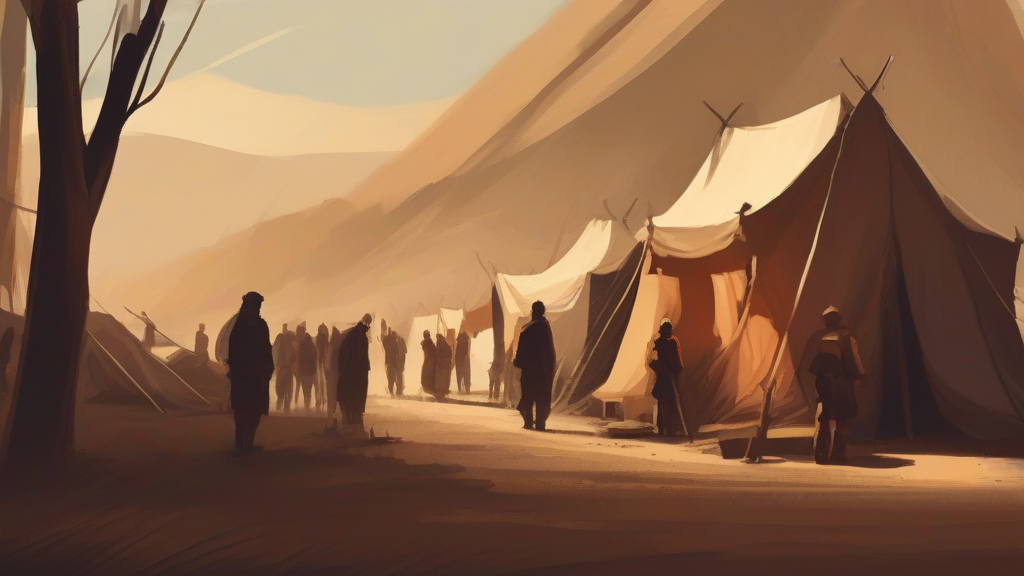
What does encampment mean?
An encampment is a temporary settlement — a collection of tents, huts, or other makeshift shelters erected by a group of people who do not intend to stay permanently. The word is used most often for military camps, where troops pitch their tents during a campaign or march, but it applies equally to refugee encampments, protest encampments, and the camps of explorers or migrant workers. Beyond naming the physical site, it can also refer to the act of settling into such a place, as when an army breaks encampment at dawn to resume its advance. More formal than the everyday words "camp" or "campsite," it carries connotations of organization, scale, and impermanence: an encampment implies many people lodged together under some authority or shared purpose. It derives ultimately from the Latin campus, meaning field, via Old French camp, making it a cousin of "campaign" and "champion."
A place where a group of people, especially soldiers or refugees, has set up temporary lodgings such as tents or huts.
"The soldiers raised their tents in an encampment beside the river."
Frequently modified by adjectives indicating purpose or duration, as in "military encampment" or "temporary encampment."
The act or condition of encamping; the occupation of a temporary camp.
"After three days of encampment in the valley, the column moved north."
Less common than the first sense; usually appears in military or historical contexts, often in phrases like "break encampment."
Regular plural. Used when referring to multiple distinct camps or settlements.
"Along the frontier there were several small encampments, each housing a company of soldiers."
The "camp" inside "encampment" is the same Latin root that gave us "campaign" and "champion" — because Roman armies literally fought from their fields.
Reviewed by Deb Chak, Editor. AI-assisted content curated by RJS Tech Solutions LLP.
Etymology of encampment
"Encampment" comes from the verb "encamp," formed in English from the prefix "en-" plus "camp," which entered Middle English from Old French. Old French camp traces back to Latin campus, meaning an open field — the same root behind "campaign," "champion," and "campus." The noun form arose in the late 16th or early 17th century as military terminology for the place where troops were lodged in the field.
How encampment is actually used
Somewhat formal or literary in register; in everyday speech people are far more likely to say "camp" or "campsite." The word often carries connotations of military organization, displacement, or impermanence, so it appears frequently in historical writing and news coverage of refugee situations.
Easily confused with encampment
"Camp" is the general term for a place with temporary lodging, while "encampment" more specifically denotes the site or arrangement of a group settled there, often on a larger or more organized scale.