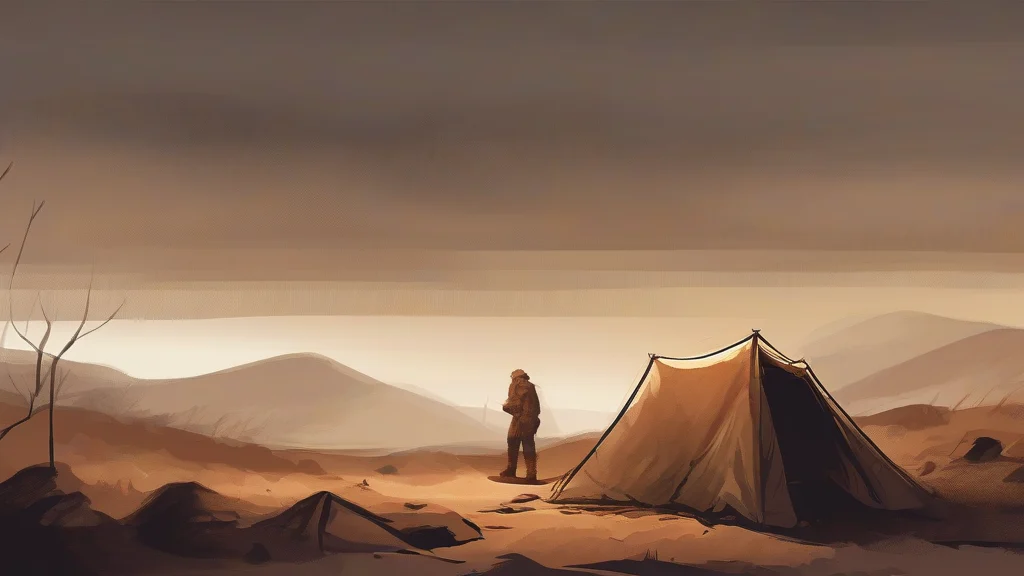
What does bivouac mean?
A bivouac is a makeshift, often roofless camp set up for a single night, most commonly by soldiers on manoeuvre or by climbers and hikers caught out in the mountains. Unlike a conventional camp, a bivouac involves little or no shelter — those bivouacking may sleep wrapped in a blanket or a lightweight sack directly on the ground, in a snow cave, or under an overhang. As a verb, 'to bivouac' means to lodge in this way. The word entered English in the early eighteenth century from French, and traces back through Swiss German to a root shared with 'watch', evoking the night guards kept around a sleeping force. It carries connotations of endurance, improvisation, and self-sufficiency rather than leisure camping, which is why it appears far more often in military history and expedition writing than in travel brochures. Knowing the word signals familiarity with that world of hard-won nights outdoors.
A temporary camp without tents or significant shelter, especially one occupied overnight by soldiers or mountaineers in the open air.
"The general ordered the troops to break bivouac before first light."
Often used attributively, as in 'bivouac site' or 'bivouac area'; the phrase 'break bivouac' means to dismantle the camp and move on.
To stay or lodge for the night in an improvised, open-air camp; to make such an encampment.
"Caught by the storm above the tree line, the climbers bivouacked in a snow hole until morning."
Standardly conjugated as 'bivouacked' and 'bivouacking'.
The regular English plural; the older French-influenced form 'bivouaque' survives only in historical writing.
"Along the valley floor lay the bivouacs of three separate regiments."
The word 'bivouac' comes from a Swiss German term meaning roughly 'an extra watch by night' — soldiers literally standing guard beside their sleeping comrades under the stars.
Reviewed by Deb Chak, Editor. AI-assisted content curated by RJS Tech Solutions LLP.
Etymology of bivouac
Bivouac was borrowed into English from French in the first half of the eighteenth century. The French term derives from Swiss German 'Beiwacht', meaning an additional watch kept at night beside troops at rest, from 'bei' ('by') plus 'Wacht' ('watch'). The Germanic root behind 'Wacht' also gives English its own native words 'watch' and 'wake', making them distant relatives of bivouac despite the word's Romance-language route into English.
Related word forms
How bivouac is actually used
Chiefly associated with military and mountaineering contexts; it carries a slightly technical or formal tone compared with plain 'camp'. The plural noun is standardly 'bivouacs', though the older French-style spelling 'bivouaque' occasionally appears in historical texts.