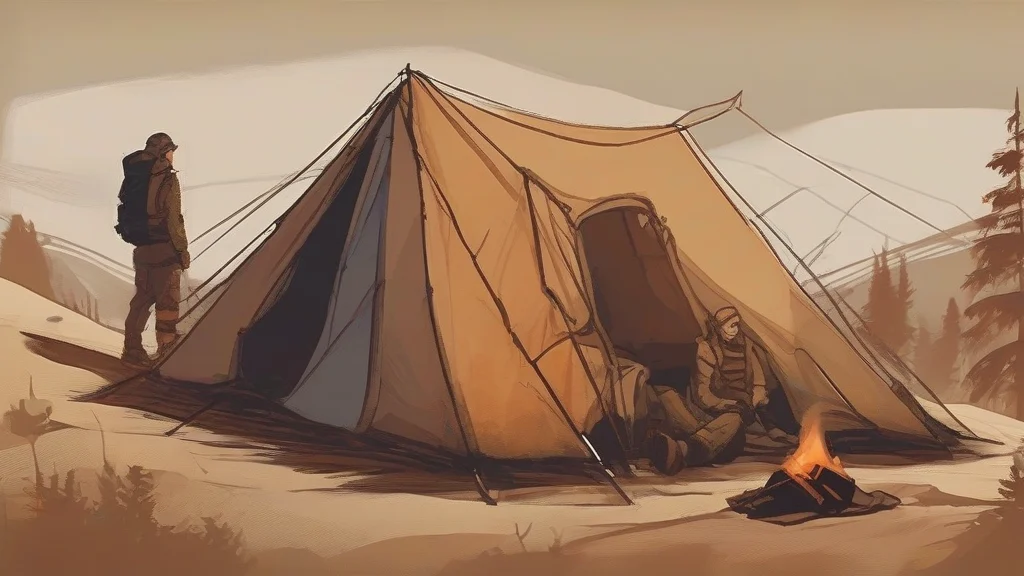
What does bivouacking mean?
Bivouacking is the practice of spending a night outdoors without a tent or any substantial shelter, relying instead on whatever natural cover — ledges, boulders, forest debris — happens to be available. It arises most often in two settings: military operations, where troops halt for the night without setting up camp, and mountaineering, where climbers caught short of a planned campsite must improvise a place to sleep. The word is the -ing form of the verb 'bivouac', which entered English in the early nineteenth century from French, ultimately tracing back to a Swiss German term for an additional night watch. Because it implies hardship, improvisation, and exposure to the elements, bivouacking carries connotations of ruggedness and self-reliance rather than leisure. It remains a specialist term, most at home in accounts of expeditions and military history, where choosing to bivouack rather than pitch camp signals urgency, necessity, or deliberate austerity.
Present participle of 'bivouac': to camp temporarily in the open air without tents or significant shelter.
"They were still bivouacking when the storm broke over the ridge."
The action or practice of camping out without shelter; occasionally, a temporary encampment of this kind.
"A week of bivouacking left them longing for a proper bed."
As a noun, this sense is less common than the verbal use; speakers more often refer to 'a bivouac' directly.
It comes from a Swiss German term meaning an 'extra watch' — soldiers who had no tent simply stayed up keeping guard through the night.
Reviewed by Deb Chak, Editor. AI-assisted content curated by RJS Tech Solutions LLP.
Etymology of bivouacking
Bivouacking derives from the verb 'bivouac', which English adopted from French 'bivouac' around the early nineteenth century during the Napoleonic era. The French word itself came from Swiss German 'Beiwacht', literally an 'additional' or 'by-watch', referring to the extra sentry duty of troops who slept rough without tents. More remotely, the element '-wacht' connects to the Germanic root behind English words such as 'watch' and 'wake'.
Related word forms
How bivouacking is actually used
Chiefly associated with military usage and mountaineering; in everyday speech, 'camping' is more common unless the shelterless aspect is being emphasised. The verb is regular but somewhat formal or specialist in register.
Easily confused with bivouacking
Camping generally involves tents or dedicated equipment, whereas bivouacking means sleeping out with minimal or no shelter.