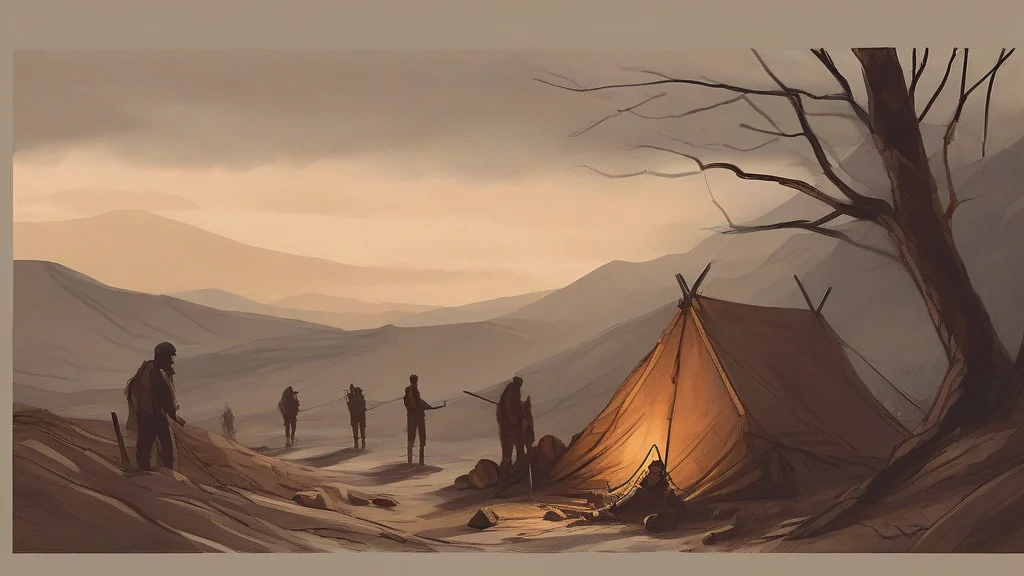
What does bivouacked mean?
Bivouacked is the past tense and past participle of the verb 'bivouac', meaning to have camped briefly and often uncomfortably, typically without tents. The word carries strong military associations: armies on the march historically bivouacked in fields and forests, resting where they could before resuming movement at first light. Beyond the battlefield, it is also used of mountaineers and long-distance trekkers who spend a night exposed on a slope or ledge because there is no time or means to pitch shelter. To say that soldiers 'bivouacked' rather than simply 'camped' suggests improvisation, hardship, and impermanence — a temporary halt rather than an established encampment. Derived via French 'bivouac' from a Swiss-German term meaning roughly 'a watch kept by night', the word entered English around the late eighteenth century during the era of Napoleonic warfare. It remains most natural in historical, military, and outdoor-adventure writing.
verb (past simple and past participle of 'bivouac')Past tense of 'bivouac': to camp temporarily, especially without tents or formal shelter, as soldiers or travellers do on a march.
- To have camped or rested temporarily in the open air or without proper shelter, especially said of military units on campaign.
"The exhausted troops bivouacked on the hillside until dawn."
"After a long day's march, the regiment bivouacked along the riverbank."
"The climbers bivouacked on a narrow ledge halfway up the face."
'Bivouac' comes from a Swiss-German word meaning literally 'by-watch' — a night spent sleeping beside your guard duty, which is why it still evokes roughing it under open skies.
Reviewed by Deb Chak, Editor. AI-assisted content curated by RJS Tech Solutions LLP.
Etymology of bivouacked
Bivouacked derives from the verb 'bivouac', which English borrowed from French in the late 18th century. The French noun 'bivouac' itself came from a Swiss-German term such as 'Beiwacht', literally 'by-watch' or 'additional watch', referring to a guard kept overnight by soldiers resting in the open. The word became widespread in English during the Napoleonic era, when open-air camping by marching armies was common.
Related word forms
How bivouacked is actually used
Chiefly used of military contexts, though also applied to mountaineers and hikers. The verb is almost always found in its inflected forms ('bivouacked', 'bivouacking'); the bare form is rare. Slightly literary or historical in register compared to plain 'camped'.