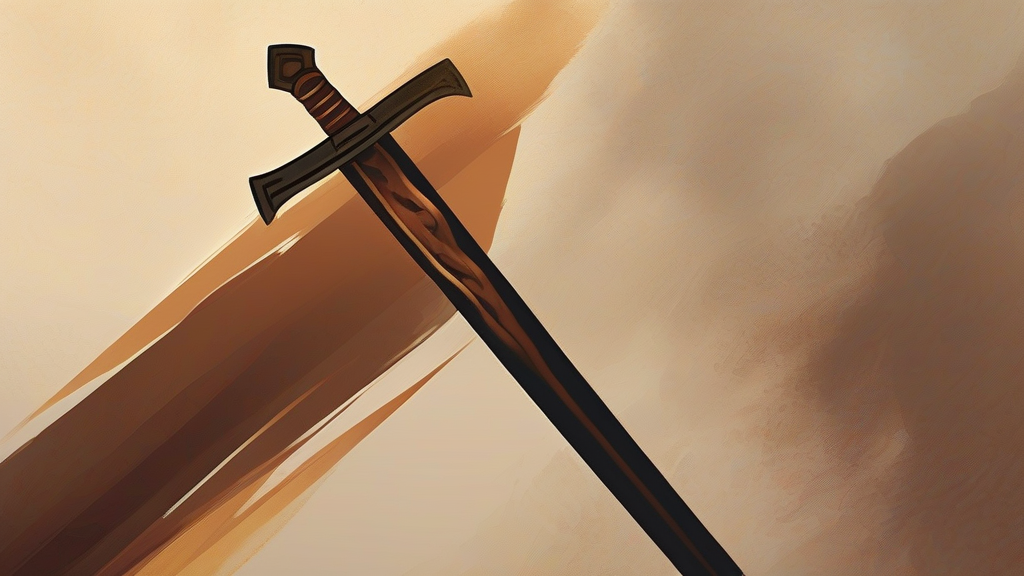
What does ensiform mean?
Ensiform is a technical adjective meaning sword-shaped: long, narrow, flat, and tapering to a sharp point. It derives from the Latin ensis, meaning sword, combined with the suffix -form, which indicates shape or form. The word appears most often in botany, where it describes strap-like, blade-edged leaves such as those of irises, gladioli, and many grasses, and in anatomy, where it labels structures resembling a blade, most famously the ensiform (xiphoid) process at the lower tip of the breastbone. Because it is precise and compact, ensiform is favored by scientists and technical writers over the plainer phrase sword-shaped, though the two are interchangeable in meaning. The word is formal in register and essentially absent from casual speech, but for readers of botanical descriptions or anatomical texts it is a useful and evocative term: one image, the gleam of a blade, conveys both the outline and the edges of whatever it describes.
adjectiveShaped like a sword; long, narrow, and pointed with sharp edges. In botany, describing leaves that are flat, tapering to a point, and edged like a blade.
- Shaped like a sword; long, narrow, flat, and tapering to a point, as certain leaves or anatomical structures.
- (Anatomy) Describing structures such as the xiphoid (ensiform) process of the sternum, which resembles a sword blade.
"The iris's ensiform leaves rose in a stiff, fan-like spray from the garden bed."
"The gladiolus sends up ensiform leaves that cut a clean vertical line against softer foliage."
"The surgeon noted that the ensiform process of the sternum projected slightly forward on imaging."
Botanists borrowed a dead Roman word for sword just to describe an iris leaf.
Reviewed by Deb Chak, Editor. AI-assisted content curated by RJS Tech Solutions LLP.
Etymology of ensiform
Ensiform comes from the Latin noun ensis, meaning sword, joined to the suffix -form, from Latin forma, meaning shape or figure. English adopted it as a scholarly descriptive term during the early modern period, alongside other Latinate shape-words such as lanceolate and fusiform. A closely related derivative is ensiferous, literally 'sword-bearing', used in zoology. The root itself has few living descendants, making ensiform one of the main places where the old Roman word for sword survives in English.
How ensiform is actually used
Primarily a technical term found in botany, anatomy, and zoology rather than everyday conversation. It carries no emotional connotation and is used descriptively and precisely. Writers seeking a more common equivalent may use 'sword-shaped' or 'sword-like'.
Easily confused with ensiform
Despite the shared '-form' ending and near-rhyme, 'uniform' means having one unvarying form, while 'ensiform' specifically means shaped like a sword.