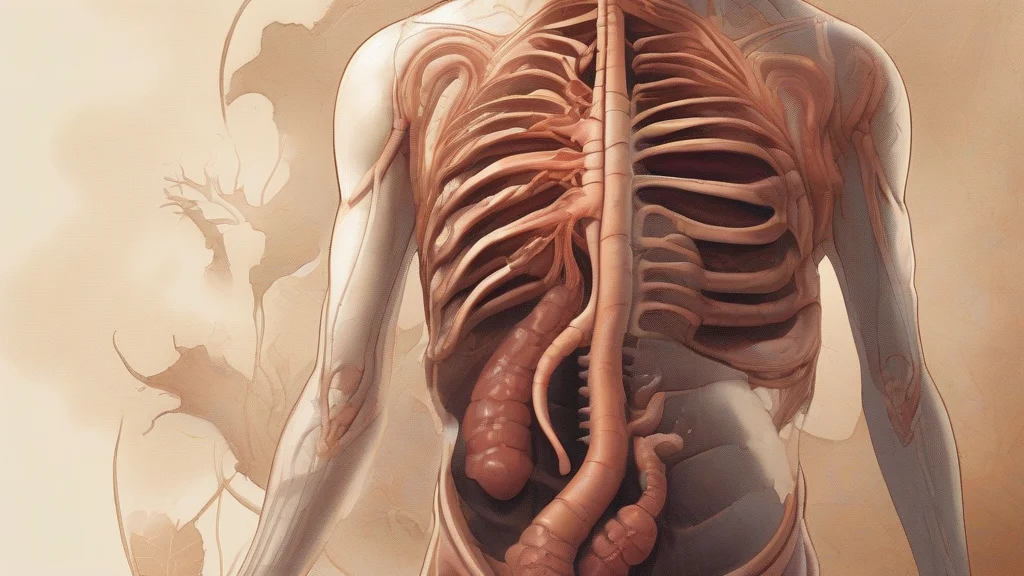
What does entrail mean?
An entrail is an internal organ of the body, particularly one of the abdominal organs such as the intestines. The word almost never appears in the singular; English speakers say 'entrails' when referring to the viscera as a whole, as in descriptions of hunting, surgery, sacrifice, or violence in literature. Beyond anatomy, 'entrails' is used figuratively for the hidden inner workings of things — the entrails of an engine, a clock, or even an institution — lending a vivid, slightly visceral image to technical or investigative writing. The register is formal, literary, or deliberately dramatic; everyday conversation favors blunter words like 'guts' or 'insides'. Historically, the word carries connotations of ritual and divination, since ancient Roman haruspices famously read the entrails of sacrificed animals to foretell the future, and this association still gives the term an air of mystery and antiquity.
nounAn inner organ of the body, especially of the abdomen; nearly always used in the plural form 'entrails' to mean the intestines or viscera collectively.
- An internal organ of the body, especially of the abdominal cavity (used chiefly in the plural).
- The inner parts of something, by extension — e.g., 'the entrails of a machine'.
"The surgeon carefully examined the animal's entrails."
"The hunter dressed the deer, removing its entrails in a single practiced motion."
"The mechanic peered into the entrails of the old engine, searching for the fault."
This is the dominant and virtually standard form; 'an entrail' is rarely used outside anatomical or archaic contexts.
"The archaeologists found pottery depicting offerings of entrails."
Ancient Roman priests called haruspices claimed they could predict the future by reading the entrails of sacrificed animals — divination by gut feeling, quite literally.
Reviewed by Deb Chak, Editor. AI-assisted content curated by RJS Tech Solutions LLP.
Etymology of entrail
'Entrail' comes from Old French 'entraile', meaning the intestines or inner parts, which itself derives from the Late Latin 'intralia', formed on Latin 'intra', meaning 'within' or 'inside'. It entered Middle English around the 14th century and has always been predominantly plural in usage. The same Latin root 'intra' gives English words such as 'internal', 'interior', and 'intramural', all sharing the core idea of inwardness.
How entrail is actually used
The singular 'entrail' is rare; the word overwhelmingly appears in the plural 'entrails'. The register is literary, medical-technical, or archaic rather than everyday — ordinary speech prefers 'guts' or 'insides'. The extended figurative use for the inner workings of machines or organizations carries a slightly dramatic or journalistic flavor.
Easily confused with entrail
'Entrail' refers to internal organs, while 'enthrall' is a verb meaning to captivate or fascinate.