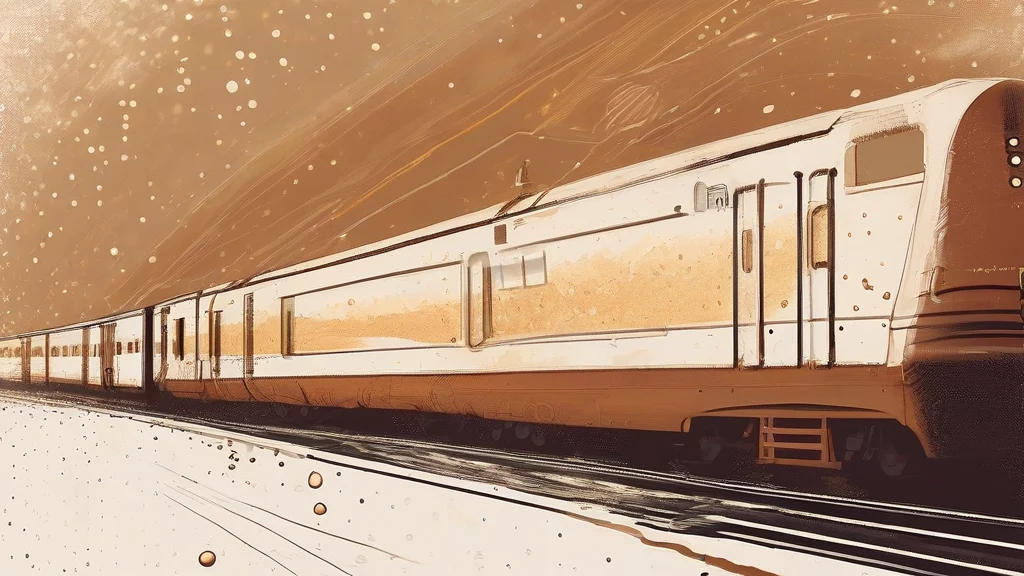
What does entrained mean?
Entrained is the past tense and past participle of the verb entrain, which has two distinct meanings. In its older, chiefly military sense, it means to board a train or to move troops by rail: soldiers entrained at a station before departure. Its more current use is scientific and technical: when a flowing fluid such as wind, water, or steam picks up and carries smaller particles, droplets, or bubbles along with it, those materials are said to be entrained. Meteorologists describe winds that entrain dust or moisture; chemical engineers speak of steam entraining water droplets; and concrete specialists refer to deliberately entrained microscopic air bubbles that improve durability. The word derives from French, combining en- with train, and ultimately traces back to Latin trahere, meaning to drag or pull. Formal and precise, entrained appears mostly in engineering, physics, and historical writing rather than everyday speech, making it a useful marker of technical fluency.
verbPast tense and past participle of "entrain": to board or put aboard a train, or (in physics and engineering) to carry or draw along particles, droplets, or air within a flowing stream.
- To board a train or be transported on one (chiefly military/historical usage).
- To carry or draw along solid particles, liquid droplets, or air bubbles within a moving fluid stream, as in engineering, meteorology, and physiology.
"The troops entrained at dawn under cover of darkness."
"Thousands of recruits entrained for the front over the course of the weekend."
"Strong winds entrained dust from the desert floor, carrying it thousands of miles out to sea."
The same word that once described soldiers climbing aboard troop trains is now used by engineers to describe air bubbles trapped inside concrete.
Reviewed by Deb Chak, Editor. AI-assisted content curated by RJS Tech Solutions LLP.
Etymology of entrained
Entrained comes from the verb entrain, borrowed from French entrainer, formed from en- (in) plus trainer (to drag, draw), which itself derives from Old French tren/trainer associated with the noun train, ultimately rooted in Latin trahere, meaning to pull or drag. The railway sense arose in the nineteenth century once trains made rail transport of troops routine, and it flourished in British military writing during the First and Second World Wars. The fluid-mechanics sense developed later among scientists describing how currents sweep material into their flow. It shares its Latin root trahere with related English words such as train, traction, and trace.
Related word forms
How entrained is actually used
The railway sense is largely historical and military, common in accounts of the World Wars but rare today. The fluid-dynamics sense is technical, appearing in physics, chemistry, meteorology, and concrete technology; as an adjective it often appears attributively, e.g. "entrained air" or "entrained water." The word is formal or technical in register and unfamiliar in everyday conversation.
Easily confused with entrained
"Entrenched" means firmly established (as in habits or fortifications), while "entrained" means either boarding a train or being carried along by a fluid flow.