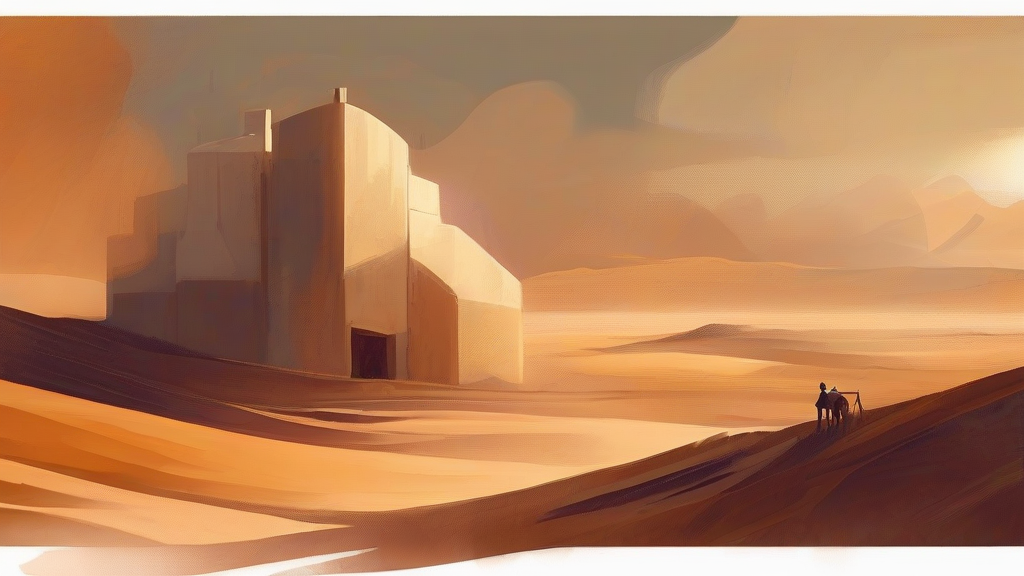
What does eolian mean?
'Eolian' is an adjective describing something made, shaped, transported, or deposited by the wind. It belongs primarily to the vocabulary of geology and physical geography, where it labels a major family of landforms and processes: eolian deposits such as sand dunes and loess, eolian erosion that sculpts rock into streamlined yardangs, and eolian transport of dust across oceans and continents. The word derives from Aeolus, the ruler of the winds in Greek mythology, whose name has long served as shorthand for all things windy — as in the aeolian harp, an instrument played by passing breezes. Writers often distinguish the spellings: lowercase 'eolian' dominates American geological usage, while 'aeolian' is preferred in British English and in classical or musical contexts. For readers of science writing, recognizing 'eolian' signals that wind, rather than water or ice, is the agent at work — a small word that quietly explains deserts, dunes, and drifting dust alike.
(Geology) Relating to or produced by the action of the wind, especially in eroding, transporting, or depositing sediment.
"Cross-bedding within the sandstone records ancient eolian dunes that once migrated across the region."
This is the dominant modern sense; American geological texts favor this spelling over 'aeolian.'
Variant of Aeolian: of or relating to Aeolus, the winds, the Aeolian Greeks, or the Aeolian musical mode.
"The poet invoked the Aeolian lyre as an emblem of inspiration arriving on the breeze."
Every sand dune on Earth is a sculpture signed by the wind — which is why geologists call them 'eolian,' borrowing their adjective from Aeolus, the Greek god who kept the winds tied up in a bag.
Reviewed by Deb Chak, Editor. AI-assisted content curated by RJS Tech Solutions LLP.
Etymology of eolian
Eolian comes from Aeolus (Greek Aiolos), the mythological keeper of the winds, combined with the adjectival suffix -an/-ian. The name Aiolos itself is connected to the Greek adjective aiolos, meaning 'swift-moving' or 'changeable,' an apt description of the wind. The capitalized form 'Aeolian' entered English in earlier centuries to describe the Aeolian Greeks, their dialect, and things pertaining to the winds, and the uncapitalized 'eolian' was adopted by geologists — particularly in America — as the technical term for wind-borne processes.
How eolian is actually used
The spelling 'eolian' without the initial 'a' is most strongly associated with American geological writing, where it is the standard form for wind-related processes; 'aeolian' remains the more common British spelling and the usual form in non-geological contexts. The word carries a technical register — it appears mainly in earth-science literature rather than everyday conversation.
Easily confused with eolian
Capitalized 'Aeolian' traditionally refers to Aeolus, the Greek keeper of the winds, to the ancient Aeolian Greeks and their dialect, or to the Aeolian musical mode, while lowercase 'eolian' is chiefly the geological term for wind-formed features.
An aeolian harp is a specific stringed instrument sounded by the wind, whereas 'eolian' alone is the general adjective describing anything produced or shaped by wind.