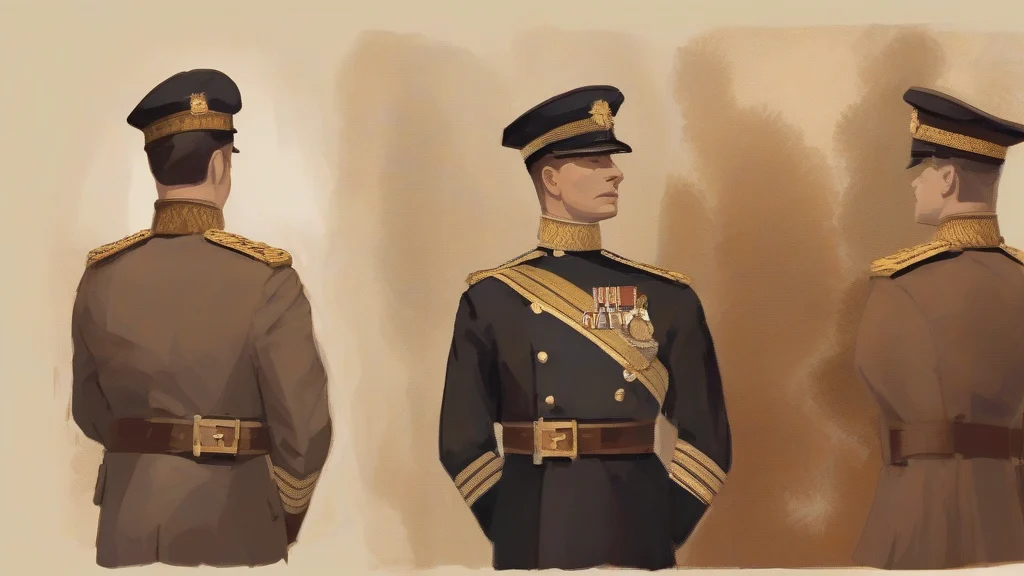
What does epaulette mean?
An epaulette is an ornamental decoration worn on the shoulder of a garment, most characteristically on the uniforms of military and naval officers, though also seen on police, airline pilots, marching bands, and ceremonial dress. Typically a stiffened strap or pad fastened near the collar and often finished with gold or silver bullion fringe, the epaulette has long served as a visible indicator of rank, branch, or seniority. The word entered English from French in the late eighteenth century and carries connotations of formality, tradition, hierarchy, and martial splendour; it appears frequently in historical writing, fiction about armies and navies, and descriptions of ceremonial attire. Because the two are usually worn as a matched pair, the plural 'epaulettes' occurs more often than the singular in ordinary usage. Figuratively, the word can occasionally suggest authority or high office — one might speak of someone 'wearing the epaulettes' to mean holding command — though this extended sense is relatively rare compared with the concrete, sartorial one.
nounAn ornamental shoulder strap or pad worn on a uniform, especially by military or naval officers, to indicate rank. It typically consists of a stiff panel covered in cloth or metal, often fringed.
- An ornamental shoulder strap or pad on a uniform, especially military, indicating rank
- (Figurative/rare) Any badge of office or visible mark of authority
"The general's gold-fringed epaulettes gleamed under the parade-ground lights."
"The newly commissioned lieutenant pinned on his epaulettes with trembling hands."
"In the airline's dress code, only senior captains wear four-bar epaulettes."
Standard plural, formed regularly with -s. More common than the singular because the ornaments are worn in pairs.
"Both officers wore silver epaulettes on their ceremonial coats."
That little gold fringe on a military officer's shoulder? Its name literally comes from the French for 'little shoulder' — and it once signalled rank so clearly you could read an officer's status from across a battlefield.
Reviewed by Deb Chak, Editor. AI-assisted content curated by RJS Tech Solutions LLP.
Etymology of epaulette
Epaulette comes from French épaulette, a diminutive of épaule meaning 'shoulder', which derives from Latin spatha ('shoulder blade', later 'sword'). The word was adopted into English during the late eighteenth century as elaborate officer uniforms became fashionable in European armies. Cognates and relatives include the French-derived 'épaule' and, through the same Latin root, English words such as 'escalate' (via Italian scala, ladder) and 'scale'.
How epaulette is actually used
The word is somewhat formal and most often appears in contexts relating to armed forces, navies, police, aviation, or historical costume. The plural 'epaulettes' is more common than the singular in everyday use, as they are typically worn in pairs. In American English both 'epaulette' and 'epaulet' spellings occur; British English strongly prefers 'epaulette'.
Easily confused with epaulette
An espadrille is a canvas shoe with a rope sole, while an epaulette is a decorative shoulder ornament on a uniform.