
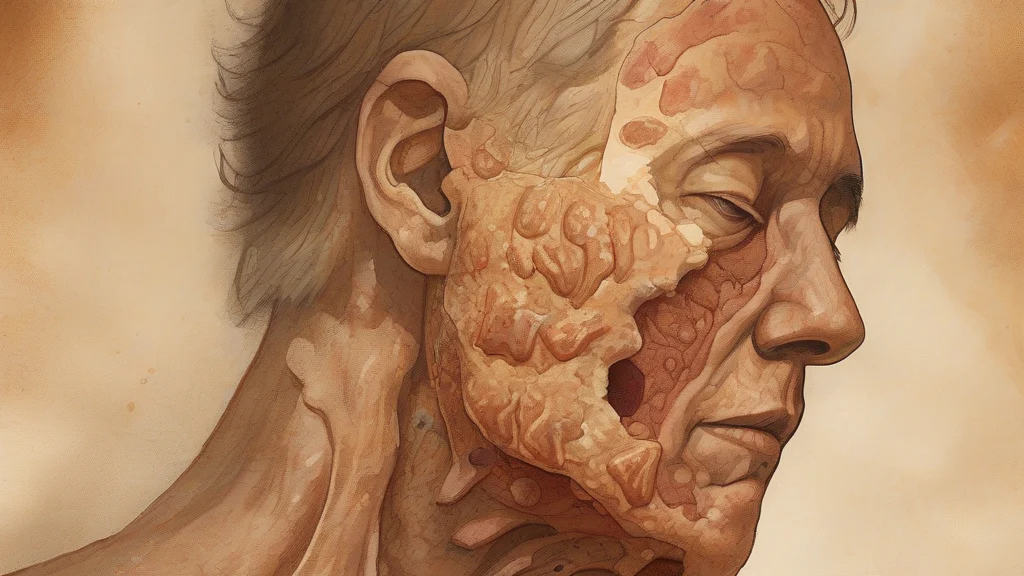
What does epithelioma mean?
An epithelioma is a tumour that arises from epithelial tissue, the layer of cells covering the body's surface and lining its organs and cavities. Depending on its behaviour, such a growth may be benign or malignant. The word was once a staple of medical vocabulary: throughout much of the nineteenth and early twentieth centuries, physicians used it as a broad label for tumours that modern pathology would classify far more precisely — most familiarly squamous cell carcinoma of the skin, sometimes called rodent ulcer when it appeared on the face. Today the term has largely fallen out of active diagnostic use, surviving mainly in historical case reports, older textbooks, and some regional or traditional practice abroad, where more exact categories such as basal cell or squamous cell carcinoma are preferred elsewhere. For general readers, then, encountering epithelioma usually signals either archival medical writing or a health system using older terminology. Its enduring value lies in what it reveals about how medicine refines its language: as understanding of cellular behaviour improved, one convenient umbrella word gave way to a family of precise diagnoses, leaving epithelioma as a linguistic fossil of an earlier era of pathology.
nounA benign or malignant tumour arising from the epithelium, the tissue that lines surfaces and cavities of the body. The term is now largely historical in medicine, having been replaced by more precise classifications such as carcinoma for malignant epithelial tumours.
- A tumour, benign or malignant, originating from epithelial tissue.
- (Historical) A term formerly used broadly for what would now be diagnosed as specific carcinomas, especially squamous cell carcinoma of the skin.
"The pathologist's nineteenth-century report described the growth simply as an epithelioma of the lip."
"The excised specimen was examined microscopically and confirmed to be an epithelioma."
"Early dermatology texts grouped many facial skin cancers under the heading of epithelioma."
Both plurals are attested; the Latinate form 'epitheliomata' appears mainly in older or more formal medical texts, while 'epitheliomas' is standard in contemporary English.
"Multiple epitheliomas were identified across the sun-exposed areas of the patient's skin."
Before modern pathology refined its terms, doctors called many skin cancers 'rodent ulcers' and classified them under a single catch-all name — epithelioma — a word now more likely to appear in century-old case reports than in a current diagnosis.
Reviewed by Deb Chak, Editor. AI-assisted content curated by RJS Tech Solutions LLP.
Where does epithelioma come from?
The word epithelioma is formed from New Latin epithelium, itself coined in the eighteenth century from Greek roots meaning roughly 'upon the nipple' (epi- 'upon' + thēlē 'nipple', originally describing tissue over the nipple), combined with the Greek-derived suffix -oma, used to denote tumours. It entered English medical usage during the nineteenth century as pathological classification expanded. It shares its base with related forms such as epithelium and epithelial, while its suffix links it to a wide family of tumour names including melanoma, glioma, and carcinoma.
How epithelioma is actually used
Epithelioma belongs to formal medical register and is chiefly encountered in older clinical literature; contemporary oncology prefers terms such as carcinoma, which specify the epithelial cell type involved. It carries a neutral, technical connotation rather than an emotive one.
Easily confused with epithelioma
Epithelium is the normal layer of tissue lining body surfaces, whereas an epithelioma is a tumour arising from that tissue.