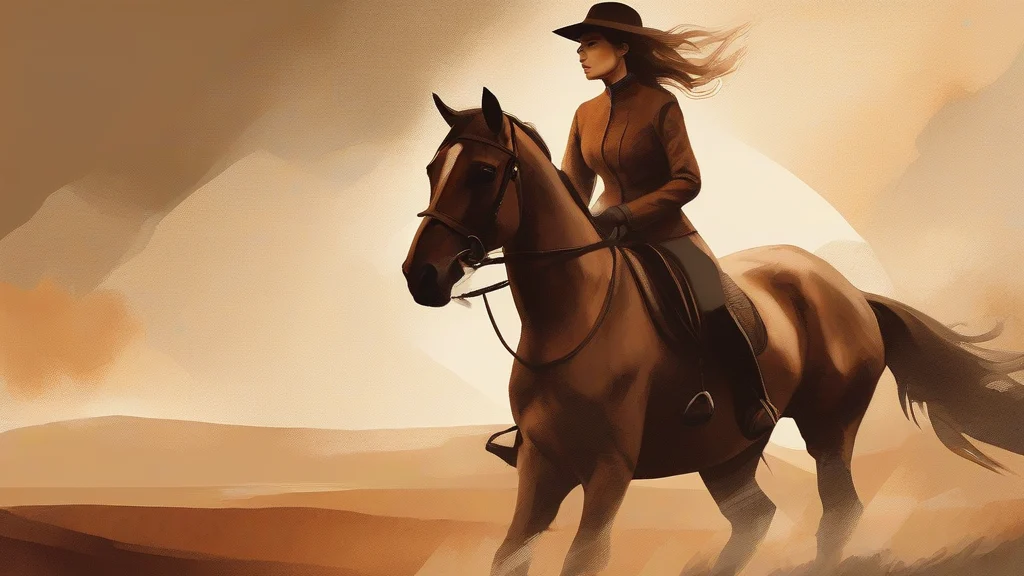
What does equestrienne mean?
An equestrienne is a woman who rides horses, particularly one noted for skill, artistry, or performance in the saddle. The word entered English from French in the nineteenth century, an era when female riders were becoming prominent figures in circuses, exhibitions, and fashionable riding schools, and it retains a slightly formal, even theatrical flavor today. It is the feminine counterpart of "equestrian," which now serves as the standard gender-neutral term for anyone who rides or works with horses. An equestrienne might be described in profiles of Olympic dressage competitors, in histories of the circus, or in biographical writing about notable women of the past. While modern usage often favors simpler terms like "horsewoman" or "rider," the word survives because it carries connotations of elegance, discipline, and mastery — evoking the image of a rider in perfect harmony with her mount.
nounA woman who rides on horseback, especially one who is skilled at riding or who performs on horseback.
- A woman skilled in or devoted to horseback riding.
- A woman who performs on horseback, as in a circus or exhibition.
"The celebrated equestrienne guided her horse through the intricate dressage routine with effortless grace."
"An accomplished equestrienne, she had competed in show jumping since her early teens."
"The circus program billed her simply as 'Madame Véloce, equestrienne extraordinaire.'"
The standard plural follows regular English noun inflection by adding -s.
"In the late nineteenth century, equestriennes were among the most celebrated stars of the circus."
Borrowed straight from French, "equestrienne" was coined in the circus age to name the daring women who rode bareback under the big top — and it remains one of the few English nouns whose very form announces the rider's gender.
Reviewed by Deb Chak, Editor. AI-assisted content curated by RJS Tech Solutions LLP.
Etymology of equestrienne
"Equestrienne" derives from the Latin adjective "equester" (or "equestris"), meaning "of or relating to horses or cavalry," itself formed from "equus," the Latin word for horse, plus the feminine agentive suffix "-enne." The word passed into English via French during the nineteenth century, when it was used to designate female riders, especially circus performers. It shares its root "equus" with words such as "equine" and "equestrian," which remain its closest cognates in English.
How equestrienne is actually used
The word is somewhat formal and literary in tone; in everyday usage, "horsewoman" or simply "rider" is more common. Because it explicitly marks gender, some contemporary writers prefer the neutral "equestrian," though "equestrienne" persists in historical, circus, and sporting contexts.
Easily confused with equestrienne
"Equestrian" refers to any horseman or horsewoman (or relating to horsemanship), while "equestrienne" is a specifically feminine term for a female rider.
Despite a similar ending, "pedestrian" means a person traveling on foot (or something dull), whereas "equestrienne" means a woman on horseback.