
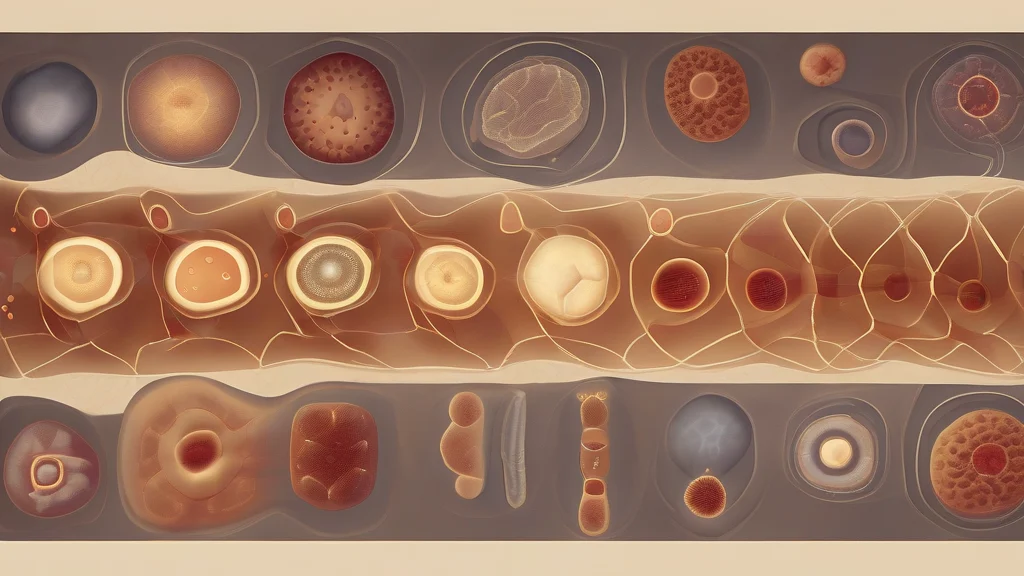
What does eukaryotic mean?
Eukaryotic describes cells and organisms whose genetic material is enclosed within a distinct, membrane-bound nucleus — the defining feature separating them from prokaryotes such as bacteria and archaea, which lack this structure. Eukaryotic cells typically also contain other membrane-bound organelles, including mitochondria and, in plants, chloroplasts, allowing specialised functions to be compartmentalised within the cell. All animals, plants, fungi, and many single-celled organisms such as amoebae and algae are eukaryotic. The term appears almost exclusively in scientific contexts — textbooks, research papers, and science journalism — where it is frequently paired with words like cell, organisms, or genome. It carries no emotional connotation; it is purely descriptive. Its counterpart, prokaryotic, is essential to understanding it: together the two terms divide all known life into two fundamental categories based on internal cell structure.
adjectiveRelating to or denoting eukaryotes — organisms whose cells contain a distinct, membrane-bound nucleus and other membrane-bound organelles.
- Of a cell or organism: possessing one or more cells that contain a distinct, membrane-bound nucleus enclosing the genetic material.
"Eukaryotic cells are far more complex than the simpler prokaryotic cells of bacteria."
"Mitochondria, the energy-producing organelles found in eukaryotic cells, are thought to have originated from ancient bacteria."
"The researchers compared gene expression in eukaryotic and prokaryotic organisms to trace the evolution of cellular complexity."
Every plant, animal, fungus, and single-celled alga on Earth is built from eukaryotic cells — yet for most of life's history, our planet belonged entirely to prokaryotes.
Reviewed by Deb Chak, Editor. AI-assisted content curated by RJS Tech Solutions LLP.
Etymology of eukaryotic
Eukaryotic derives from the Greek elements eu- meaning 'good' or 'true', and karyon meaning 'nut' or 'kernel', a reference to the nucleus at the centre of the cell. The term was coined in the 20th century alongside its opposite, prokaryotic (from Greek pro-, 'before'), as biologists came to recognise the fundamental division between nucleated and non-nucleated cells. Related English words drawing on the same Greek root karyon include karyotype, the chromosomal profile of a cell.
Related word forms
How eukaryotic is actually used
A technical term used chiefly in biology, biochemistry, and related sciences. The spelling 'eucaryotic' is an older variant, now largely superseded by 'eukaryotic'.
Easily confused with eukaryotic
Prokaryotic describes organisms such as bacteria whose cells lack a membrane-bound nucleus, whereas eukaryotic describes those whose cells possess one.