
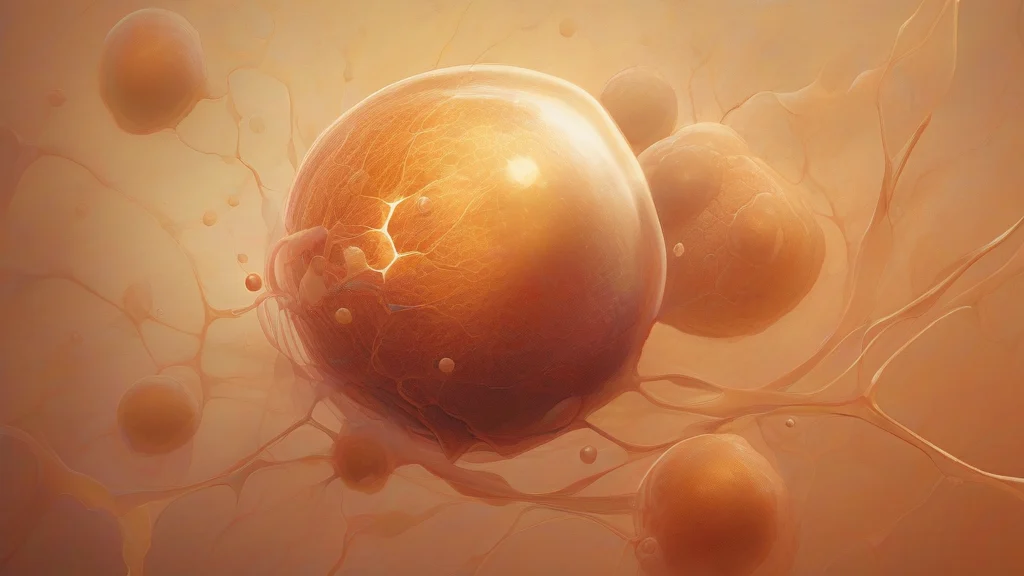
What does karyoplasm mean?
Karyoplasm is a specialist biological term for the gel-like material occupying a cell nucleus apart from the chromosomes and the nucleolus. In microscopic descriptions of cells, it is the background medium in which nuclear structures are suspended and through which substances move between nuclear and cytoplasmic compartments. The word is chiefly used in cell biology, histology, and related technical writing; outside those fields it will usually be encountered in dictionaries or reference works. Karyoplasm is often treated as equivalent to nucleoplasm, although usage can vary with the conventions of a particular text. It should not be confused with cytoplasm, the larger portion of a cell outside the nucleus. Knowing the distinction is useful because nucleus and cytoplasm are fundamental concepts in biology, while karyoplasm names the part of the nuclear environment not covered by the more familiar terms chromosome and nucleolus. The term is precise rather than poetic, but its formation from Greek roots makes it an elegant example of how scientific vocabulary preserves older images, such as a kernel and molded matter, in modern description.
nounThe gel-like ground substance of a cell nucleus, excluding the chromosomes and the nucleolus.
- The gel-like ground substance of a cell nucleus, excluding the chromosomes and nucleolus.
"Using live-cell imaging, the researchers tracked molecules as they moved through the karyoplasm toward the nuclear pores."
"Using live-cell imaging, the researchers tracked molecules as they moved through the karyoplasm toward the nuclear pores."
"During cell division, changes in the karyoplasm accompany the reorganization of chromatin."
The plural is grammatically standard but uncommon outside specialist writing.
"Comparisons between karyoplasms from healthy and damaged cells revealed significant differences."
Karyoplasm names the nucleus's gel-like background: everything in the nuclear interior except the chromosomes and the nucleolus.
Reviewed by Deb Chak, Editor. AI-assisted content curated by RJS Tech Solutions LLP.
Etymology of karyoplasm
Karyoplasm combines Greek karyon, meaning “nut” or “kernel” and used for the cell nucleus, with plasma, meaning “formation” or “molded substance.” The compound belongs to the vocabulary of modern cell biology and parallels terms such as nucleoplasm and cytoplasm; related Greek-derived words include karyotype, karyocyte, and karyokinesis.
How karyoplasm is actually used
A highly specialized formal term used chiefly in cell biology, histology, and related technical literature. It is uncommon in general writing.
Easily confused with karyoplasm
Karyoplasm is the material within a cell nucleus, whereas cytoplasm is the material surrounding the nucleus in the cell.