
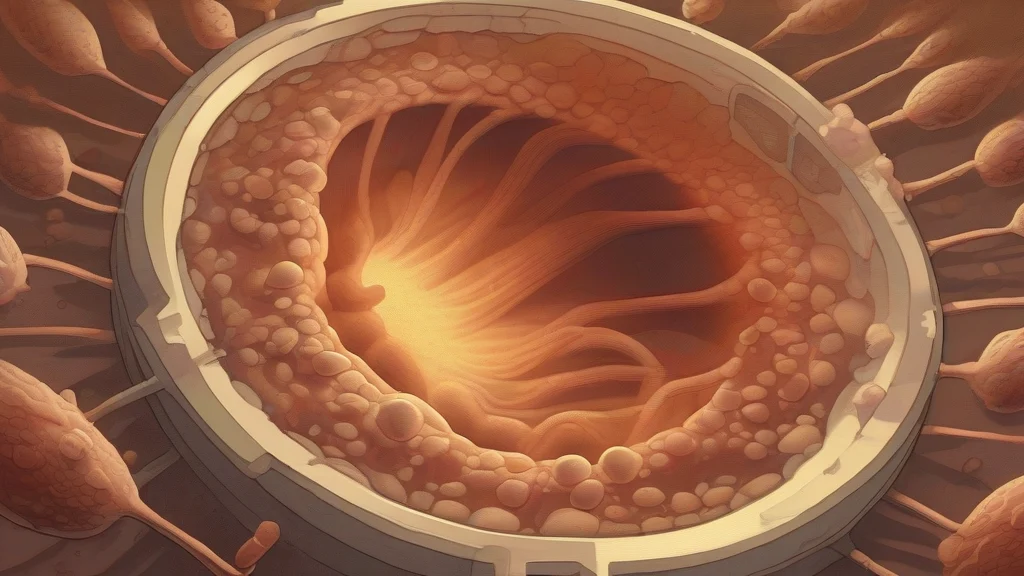
What does endoplasm mean?
Endoplasm is a noun used in biology to describe the inner region of a cell's cytoplasm — the semi-fluid substance enclosed by the cell membrane. Denser, more granular, and more fluid than the outer layer known as ectoplasm, the endoplasm houses most of the cell's organelles, including the nucleus, mitochondria, ribosomes, and the endoplasmic reticulum, and it serves as the main site of the cell's metabolic activity. The term appears chiefly in cytology, histology, and introductory biology texts, usually in contrastive discussions of cytoplasmic structure or in descriptions of cyclosis, the streaming movement of this internal material. Derived from Greek roots meaning 'within' and 'formed substance', it entered scientific English in the nineteenth century alongside related coinages such as protoplasm and cytoplasm. Though technical rather than everyday vocabulary, it remains essential terminology for describing cellular anatomy.
nounThe inner, more fluid and granular portion of the cytoplasm of a cell, as distinguished from the outer, clearer layer (ectoplasm). It contains most of the cell's organelles and is the principal site of metabolic activity.
- The inner, granular, fluid portion of a cell's cytoplasm, containing most organelles and the site of most metabolic activity.
"Under the microscope, the streaming movement of the endoplasm was clearly visible within the amoeba's cell body."
"Food vacuoles form as particles are engulfed and drawn into the endoplasm of the amoeba."
"Cyclosis, the circulation of endoplasm within the cell, helps distribute nutrients throughout the cytoplasm."
Rarely pluralized; when referring to cells generally, biologists typically use the uncountable singular form.
"The study compared the viscosity of the endoplasms of several amoeboid species."
The 'endoplasm' inside your cells gave its name to one of biology's most famous structures: the endoplasmic reticulum, the cellular highway where proteins are built.
Reviewed by Deb Chak, Editor. AI-assisted content curated by RJS Tech Solutions LLP.
Etymology of endoplasm
Endoplasm derives from the Greek prefix 'endo-' meaning 'within' combined with 'plasma', from 'plassein', meaning 'to mould or form'. It was coined in the mid-nineteenth century by German cytologists studying cell structure, appearing in English scientific writing around the same period. It shares its root with cognate biological terms such as protoplasm, cytoplasm, ectoplasm, and karyoplasm, all formed on the same Greek element for 'formed substance'.
How endoplasm is actually used
A technical term used almost exclusively in cytology and biology textbooks; it is rarely encountered in general writing. It is typically discussed in contrast with ectoplasm.
Easily confused with endoplasm
Ectoplasm is the outer, clear, gel-like layer of cytoplasm just inside the cell membrane, whereas endoplasm is the inner, granular, more fluid region containing the organelles.