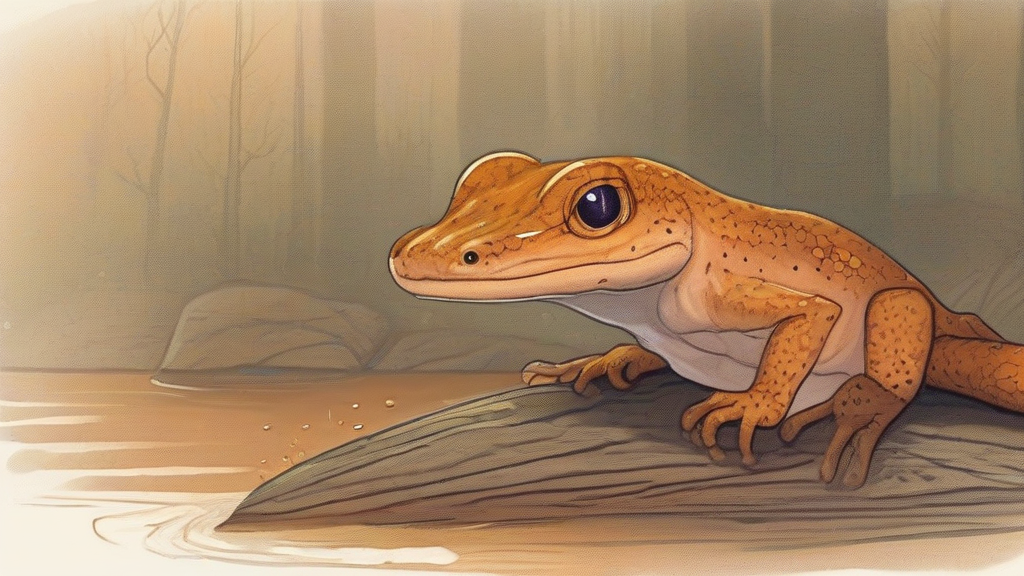
What does ewt mean?
Ewt is an obsolete or dialectal name for what modern English calls a newt — a small amphibian with a slender body and tail, related to salamanders, that lives both on land and in fresh water. The word is rarely encountered outside historical writing or discussions of language change, but it holds a special place in English lexicography: it is actually the older form of the word. In Middle English the creature was called an ewte, but over time speakers reinterpreted the phrase, treating the n of the article as part of the noun, producing a newte and eventually newt. This process, known as misdivision or metanalysis, gave us one of the most memorable examples of how everyday speech reshapes vocabulary. Today ewt appears mainly in dictionaries, etymology discussions, and literary or antiquarian contexts, serving as a reminder that even familiar words carry hidden histories shaped by centuries of spoken usage.
nounAn ewt is an obsolete or dialectal variant of "newt," a small amphibian resembling a lizard that lives in water and on land. The word survives chiefly as a historical curiosity and as the source from which "newt" itself arose through misdivision.
- A small amphibian of the salamander family; an obsolete or dialectal form of "newt."
"The old bestiary described the ewt as a creature equally at home in pond and hedgerow."
"In medieval texts the ewt was often confused with the lizard."
"The pond was said to teem with ewts, though today we would call them newts."
The plural follows the regular pattern; it occurs only in historical or dialectal texts, since the modern plural is "newts."
"The chronicle noted that the marshes were full of ewts in spring."
The newt got its name by mistake: people heard 'an ewte' so often they started saying 'a newte' — and the error stuck.
Reviewed by Deb Chak, Editor. AI-assisted content curated by RJS Tech Solutions LLP.
Etymology of ewt
Ewt derives from Middle English ewte, itself from Old English efete via Anglo-Norman forms such as euete. In Middle English the noun appeared after the indefinite article as an ewte, and speakers gradually reanalyzed this as a newte, transferring the n to the noun and giving rise to modern newt. Its Old English ancestor also survives in the form eft, which names the same amphibian. Ewt therefore represents the earlier side of a famous example of metanalysis in English word formation.
How ewt is actually used
Ewt is not used in modern standard English except when discussing etymology or historical texts. Writers should use "newt" for the animal. The word is of genuine interest to linguists because it illustrates metanalysis — the shifting of the boundary between article and noun.
Easily confused with ewt
Newt is the standard modern English word for the animal, while ewt is its older variant form; they denote the same creature.
Eft is another historical name for a newt, especially the terrestrial juvenile stage of some species, whereas ewt is simply a spelling variant of newt.