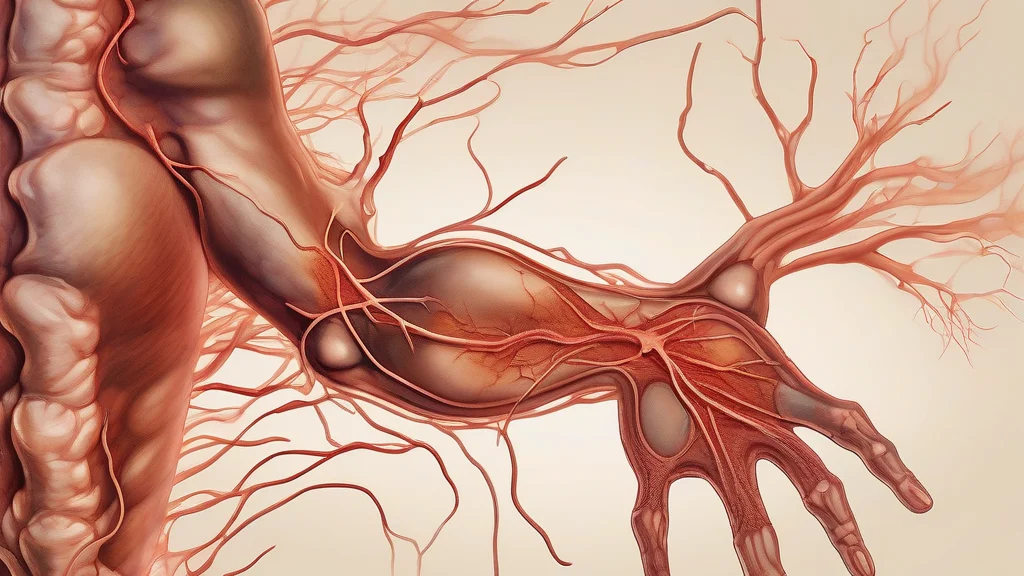
What does extravascular mean?
Extravascular is an adjective used in medicine and biology to describe anything situated or occurring outside the blood vessels and lymphatic vessels. Its opposite is intravascular, meaning within the vessels. The word appears frequently in discussions of body fluid distribution: much of the body's water resides in the extravascular compartment, divided between the fluid inside cells and the interstitial fluid between them. Clinicians speak of extravascular lung water when assessing conditions such as heart failure, and pharmacologists use the term when describing how drugs pass from the bloodstream into surrounding tissues, as well as for routes of administration that bypass the vessels entirely, such as oral or intramuscular delivery. Because it is built from transparent Latin elements — extra- ('outside') and vasculum ('small vessel') — its meaning is easy to decode once encountered. Though firmly technical in register, it is a precise and useful term for anyone reading medical literature.
adjectiveSituated or occurring outside the blood vessels or lymphatic vessels of the body. Used chiefly in medical and physiological contexts to describe fluids, cells, spaces, or processes located beyond the vessel walls.
- (Anatomy & Physiology) Located or occurring outside the blood vessels or lymphatic vessels.
"Fluid accumulated in the extravascular space, causing the tissue to swell."
"The drug moved rapidly from the bloodstream into the extravascular tissues."
"Extravascular lung water is a key marker in assessing patients with heart failure."
Every drop of blood stays inside your vessels for life — but 'extravascular' names everything just beyond that thin wall, where most of your body's fluid actually lives.
Reviewed by Deb Chak, Editor. AI-assisted content curated by RJS Tech Solutions LLP.
Etymology of extravascular
Extravascular derives from Latin roots: the prefix extra-, meaning 'outside' or 'beyond', combined with vasculum, a diminutive of vas meaning 'vessel', plus the adjectival suffix -ar. It was formed on the model of earlier anatomical terms such as vascular and intravascular, entering English scientific vocabulary alongside them as modern physiology developed its terminology for circulation and body fluids. It shares the root vas with related English borrowings including vessel, vase, and vascular.
How extravascular is actually used
A technical term used almost exclusively in medicine, physiology, and pharmacology; it is rarely encountered in everyday speech. In pharmacology, 'extravascular administration' describes any route of drug delivery other than directly into a blood vessel, such as oral or intramuscular dosing.
Easily confused with extravascular
Intravascular means situated within the blood or lymphatic vessels, whereas extravascular means outside them.
Extracellular means outside the cells generally, while extravascular refers specifically to being outside blood and lymphatic vessels.