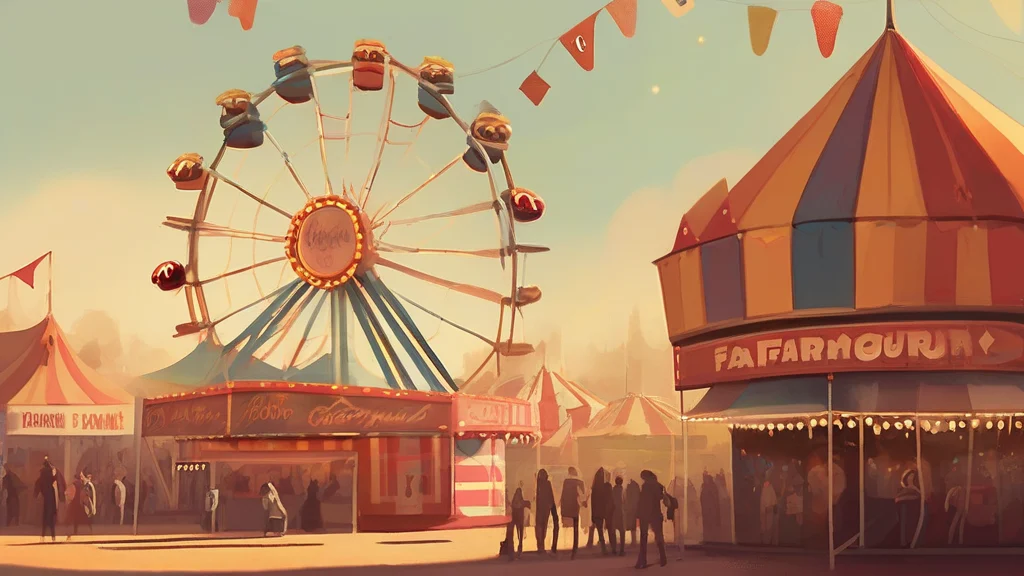
What does fairground mean?
A fairground is an area of land set aside for holding fairs, circuses, and travelling amusement shows. It typically hosts rides such as carousels and ferris wheels, sideshows, game stalls, food vendors, and other entertainments, either on a seasonal basis or as a permanently designated site. The term is standard in both British and American English, though British speakers also use "funfair" for the event itself and Americans often say "carnival" or "midway." In everyday language, fairground most often appears attributively — fairground rides, fairground attractions, fairground organs — describing things associated with these festive spaces. The word carries connotations of excitement, noise, lights, and nostalgia, evoking childhood memories and traditional community gatherings. It derives simply from "fair," in the sense of a public entertainment event, combined with "ground," making its meaning transparent: quite literally, the ground where the fair takes place.
nounAn open area or set of grounds where a fair, circus, or travelling amusement show is held, typically featuring rides, stalls, and entertainment.
- A permanent or temporary site where fairs, circuses, or travelling amusements are held.
"The children spent the whole afternoon on the fairground rides."
"The annual show drew huge crowds to the fairground on the edge of town."
"A battered fairground carousel stood rusting behind the abandoned pavilion."
The plural is common when referring to multiple such sites, but note that American English sometimes uses "fairgrounds" (plural form) even for a single site, treating it like "grounds" of a building.
"The county owns several fairgrounds across the state."
The waltzing fairground organs that once blared across Victorian fairs are now prized antiques, some fetching more than the rides they once accompanied.
Reviewed by Deb Chak, Editor. AI-assisted content curated by RJS Tech Solutions LLP.
Etymology of fairground
The word fairground is a straightforward English compound formed from "fair" — meaning a periodic gathering for entertainment and trade, which itself comes from the Old French "feire," ultimately from the Latin "feria" meaning festival or holiday — combined with "ground," referring to a piece of land. The compound arose naturally to name the sites where travelling fairs pitched their attractions. Its Latin root "feria" also gives English the words "ferial" and "festivity-adjacent" terms through related Romance forms, while "fair" in this sense is unrelated to "fair" meaning beautiful or just, which comes from Old English "fæger."
How fairground is actually used
"Fairground" is used in both British and American English, though "funfair" is more common in British English and "carnival" or "amusement park" often replaces it in American usage. The word frequently functions attributively, as in "fairground rides" or "fairground attractions."
Easily confused with fairground
A fairway is the closely mown strip of grass on a golf course between tee and green, whereas a fairground is a site for fairs and amusement rides.