What does funfair mean?
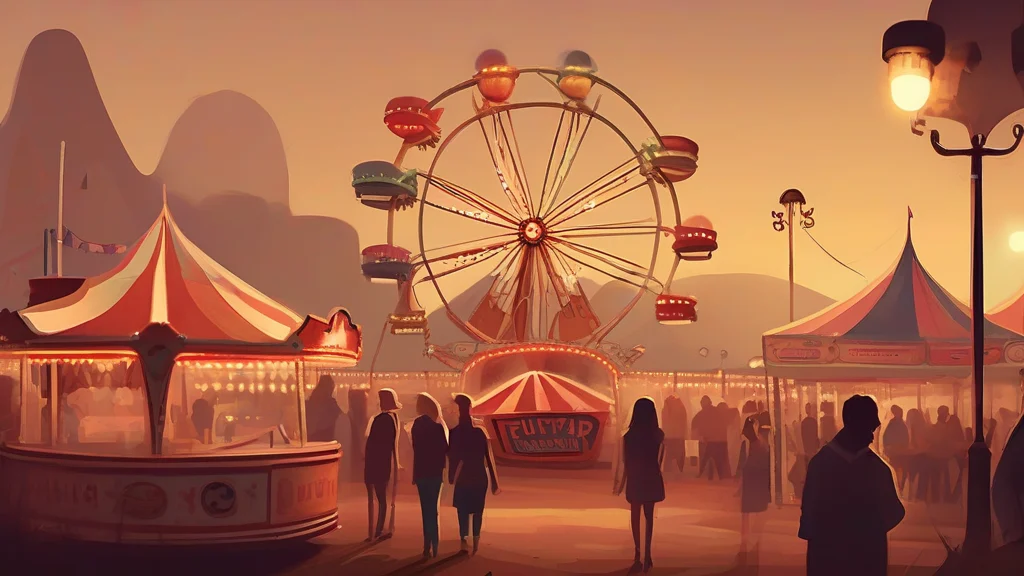
A funfair is a British English term for an outdoor amusement park of a temporary or travelling nature, comprising mechanical rides such as carousel, Ferris wheels, and dodgems alongside game stalls, sideshows, and food stands selling treats like candyfloss and toffee apples. Unlike a permanent theme park, a funfair typically arrives in a town or on common ground for a limited season — often linked to holidays, wakes weeks, or local festivals — before moving on. The compound joins 'fun' with 'fair', signalling entertainment as distinct from the older trading fair. The word evokes strong nostalgia in Britain, conjuring images of showmen's wagons, waltzers, and bright lights at dusk. In North America the equivalent spectacle is usually called a carnival, making 'funfair' one of those distinctly regional vocabulary items useful to know when reading British fiction or travelling in the UK.
nounA funfair is a temporary outdoor amusement park consisting of rides, stalls, sideshows, and other entertainments, typically visiting a town for a limited period.
- A temporary outdoor amusement park with rides, game stalls, and sideshows that visits a location seasonally or for a limited period.
"The travelling funfair arrived on the common for the bank holiday weekend, its Ferris wheel visible for miles."
"The children spent their pocket money on the coconut shy at the village funfair."
"Every October, the funfair pitches up on the moor with its helter-skelter and dodgems."
Standard plural; used mainly when discussing multiple events or sites.
"Travelling funfairs visit dozens of towns across England each summer."
The word 'funfair' exists almost nowhere outside Britain — Americans call the same waltzer-and-candyfloss world a 'carnival'.
Reviewed by Deb Chak, Editor. AI-assisted content curated by RJS Tech Solutions LLP.
Etymology of funfair
Funfair is a twentieth-century British compound formed from 'fun' (an older word of uncertain but possibly Middle English origin meaning merriment) and 'fair' (from Latin 'feriae', meaning festival days, which entered English through Old French 'feire'). The Latin root 'feriae' also gives us 'festival', 'fiesta', and 'holiday', all referring to celebratory occasions. The compound emerged as travelling amusements separated conceptually from traditional trade fairs during the nineteenth and early twentieth centuries.
How funfair is actually used
Primarily British usage; American English uses 'carnival' or 'amusement park' instead. The word carries nostalgic connotations of traditional travelling showgrounds, candyfloss, and fairground organs.
Easily confused with funfair
A carnival is a festive season of public celebration (as in Rio or Notting Hill), whereas a funfair specifically refers to the collection of rides and stalls itself.
A fair is traditionally a market or trading event that may include entertainment, while a funfair is purely an amusement attraction with rides and games.