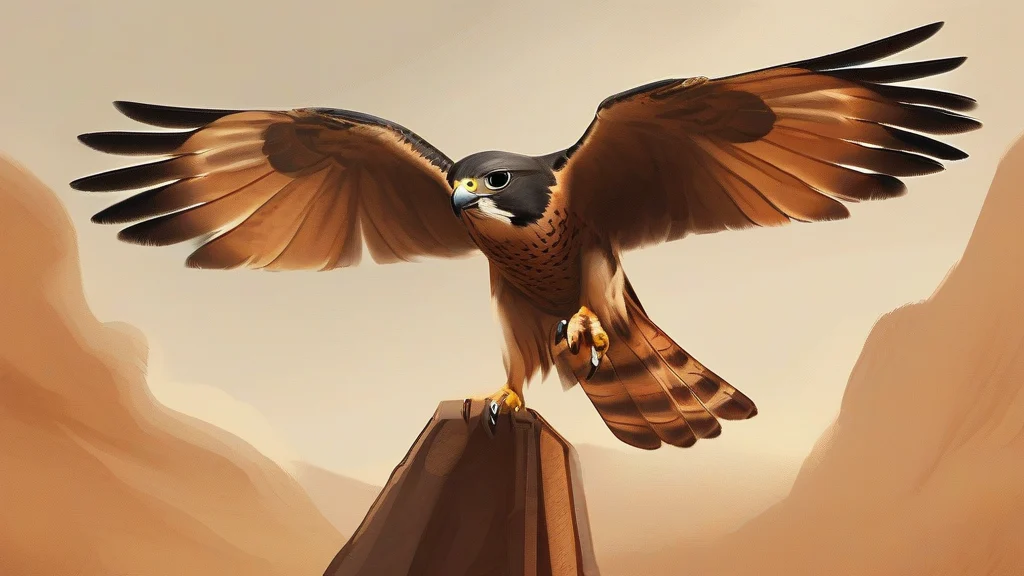
What does falconet mean?
A falconet is, in modern usage, any of the world's smallest falcons — dainty birds of prey found in Africa and southern Asia, including the pygmy falcon and the members of the genus Microhierax. These birds are barely larger than sparrows, and some famously shelter in the massive communal nests of weaver birds. The word is formed by attaching the diminutive suffix '-et' to 'falcon', reflecting the birds' unusually small size. Historically, the same word carried a second, unrelated meaning: a falconet was also a light bronze cannon, small enough to be moved with relative ease, used widely in European warfare from roughly the fifteenth to seventeenth centuries. Today the ornithological sense dominates, while the artillery sense survives mostly in military history writing. Because it names more than one species and appears in specialist contexts, 'falconet' is a relatively rare word, but its elegant diminutive formation makes it a tidy example of how English uses suffixes to signal scale.
Any of various very small falcons of Africa and southern Asia, notably the pygmy falcon and the members of the genus Microhierax.
"From its perch inside a weaver's nest, the falconet scanned the savannah for insects and small lizards."
Usually encountered alongside a specific common name, since 'falconet' covers several distinct species rather than a single bird.
Historically, a small, lightweight cannon used in European warfare from about the fifteenth to the seventeenth century.
"The fortress garrison mounted a falconet above the gatehouse to sweep the approach road."
This sense is now largely historical and appears chiefly in military-history literature.
Standard English plural; applies equally to the ornithological and historical-artillery senses.
"Pairs of falconets often share a single weaver colony."
The word 'falconet' once meant two very different things: a bird so tiny it hunts from weaver nests, and a cannon small enough to be carried by one person.
Reviewed by Deb Chak, Editor. AI-assisted content curated by RJS Tech Solutions LLP.
Etymology of falconet
The word derives from Middle French 'faucon', which itself came ultimately from Latin 'falco' (the source also of 'falconry' and 'falconer'). English adopted the base word as 'falcon', and added the French diminutive suffix '-et', producing a name that literally means 'little falcon'. The artillery use borrowed the existing word for the small hunting bird and applied it to an equivalently small gun, a naming practice common among early modern cannon types. Exact first-attestation dates for each sense are not certain enough to state precisely, but both were established well before the eighteenth century.
How falconet is actually used
In modern ornithological use, 'falconet' names several distinct tiny falcon species rather than a single taxon, so it is usually encountered with a qualifying common name. The artillery meaning is now almost entirely historical, appearing mainly in military-history contexts. Both senses are uncommon words overall.
Easily confused with falconet
A falcon is any bird of prey in the genus Falco and related genera, while a falconet refers specifically to the very smallest falcons or, historically, to a small light cannon.