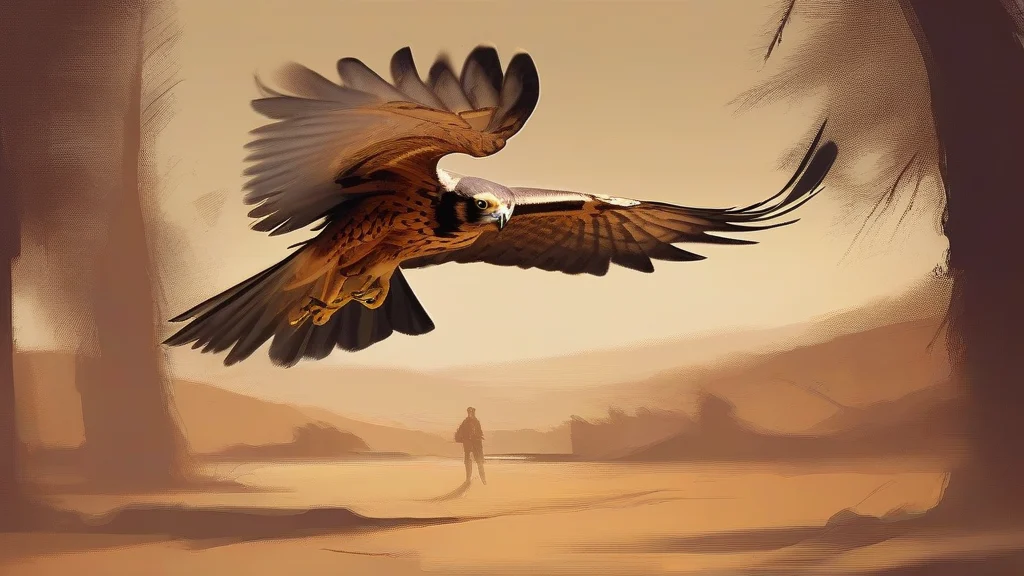
What does falconry mean?
Falconry is the sport and art of hunting wild animals with trained birds of prey — most famously falcons such as the peregrine, but also hawks, eagles, and owls. The word refers both to the chase itself and, more broadly, to the whole craft of keeping, training, and flying a raptor, work that demands patience, deep knowledge, and a close working bond between bird and handler. Once known as 'hawking' in medieval Europe, where different species of bird were traditionally assigned to different social ranks, falconry has been practised for thousands of years across Asia, the Middle East, and Europe, and it survives today as a licensed pursuit governed by conservation laws in many countries. The person who practises it is called a falconer. The term carries strong associations of heritage, discipline, and aristocratic history, which makes it a distinctive and evocative word wherever hunting, wildlife, or traditional country sports are discussed.
nounThe sport or practice of hunting wild animals, especially birds and small game, using trained birds of prey such as falcons and hawks.
- The sport and practice of hunting wild quarry using trained birds of prey (especially falcons).
- More broadly, the art and husbandry of keeping, training, and flying birds of prey, whether or not for hunting.
"After years of patient training, she finally took up falconry, flying her peregrine falcon at dawn over the open moor."
"Falconry was once the pastime of kings, its practice regulated by strict social hierarchies that assigned particular raptors to particular ranks."
"She spent her weekends learning falconry, mastering how to weigh, feed, and fly a kestrel under the guidance of an experienced falconer."
The plural 'falconries' is grammatically valid but rare in modern English; falconry is nearly always used as an uncountable singular. Plural usage appears mainly in older or scholarly texts referring to multiple distinct traditions or establishments of the sport.
"Medieval Europe saw many distinct falconries, each with its own customs regarding which birds might be flown."
Falconry is over 4,000 years old — so ancient that it appears on the UNESCO Intangible Cultural Heritage lists of multiple countries, and it may be the oldest sport still practised by humans.
Reviewed by Deb Chak, Editor. AI-assisted content curated by RJS Tech Solutions LLP.
Etymology of falconry
Falconry derives from 'falcon', the bird's name, combined with the suffix '-ry' denoting a practice or body of practitioners, much like 'husbandry' or 'forestry'. The word 'falcon' itself entered English from Old French 'faucon', which in turn came from Late Latin 'falco'. The suffix '-ry' comes from Old French '-ie', indicating a collective activity. Cognates include 'falconer' (the practitioner) and related Romance forms such as Italian 'falconiere' and French 'fauconnier'.
Related word forms
How falconry is actually used
Falconry is a formal, somewhat specialist term; it carries connotations of tradition, aristocratic heritage, and craftsmanship. It is almost always uncountable and used as a singular mass noun ('falconry is', not 'falconries are' in ordinary use). In everyday speech, 'falconer' (the practitioner) is more commonly encountered than 'falconry' itself.
Easily confused with falconry
A falcon is the bird of prey itself, while falconry is the sport or practice of hunting with trained falcons.
Hawking is a closely related term historically used for hunting with hawks (a broader set of raptors), whereas falconry strictly refers to hunting with long-winged falcons; today 'hawking' can also mean selling goods aggressively or clearing the throat.