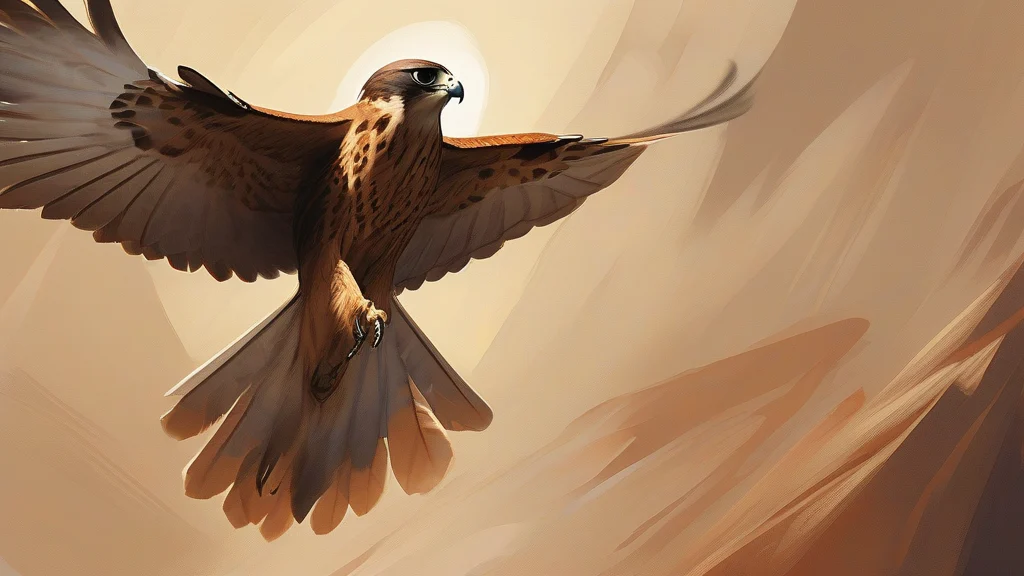
What does falconine mean?
Falconine is a formal adjective describing something of, relating to, or resembling a falcon. It most often appears in nature writing to characterise the bird's defining traits — long pointed wings, swift powerful flight, and razor-sharp hunting instincts — but it also lends itself to figurative use, where a person's keen eyesight, intense stare, or sudden decisive movement may be called falconine. The word carries strong connotations of speed, precision, and predatory focus, making it a vivid alternative to more general terms like hawklike or raptorial. Because it derives from the same Latin root as falcon itself, it belongs to a small family of related terms including falconer, falconry, and falconet. Though uncommon in everyday conversation, it rewards writers who want an exact, evocative term for falcon-like qualities.
adjectiveOf, relating to, or resembling a falcon; characteristic of falcons, especially in swift, agile hunting flight or sharp predatory instinct.
- Relating to or resembling a falcon in appearance, movement, or temperament, especially its swift flight and keen predatory focus.
"The peregrine's falconine speed left the dove no chance of escape."
"Her falconine stare swept the room until it settled, unblinking, on the culprit."
"The gyrfalcon dropped from the cliff in a falconine stoop, wings tucked tight against the wind."
Falcons gave English not just a bird's name but a whole descriptive vocabulary — 'falconine' lets you call someone sharp-eyed and swift-striking without mentioning a single feather.
Reviewed by Deb Chak, Editor. AI-assisted content curated by RJS Tech Solutions LLP.
Etymology of falconine
Falconine derives from the Latin falco, falconis, meaning falcon — a name often linked to the sickle-like shape of the bird's talons, echoing Latin falx, though this connection is debated — combined with the adjectival suffix -ine, which forms adjectives meaning 'of the nature of'. The word entered English in the modern era alongside other natural-history terminology. Its cognates within English include falcon itself, borrowed via Old French from Medieval Latin, together with falconer, falconry, and the small falcon called the falconet.
How falconine is actually used
A formal, literary adjective, rare outside nature writing and elevated prose. It carries connotations of speed, precision, and piercing alertness, and is often applied figuratively to a person's eyes, gaze, or bearing.
Easily confused with falconine
Leonine means lion-like (from Latin leo), whereas falconine means falcon-like (from Latin falco); the two share an adjective-forming suffix but describe entirely different animals.